Written by
Maui Snorkeling, operating tours to Molokini Crater, Turtle Town, and Coral Gardens from Māʻalaea Harbor since 1985. Tours are led by USCG-licensed captains aboard a
USCG-inspected passenger vessel.
Quick Answer
Why are dolphins good luck? In some maritime traditions, dolphins symbolized protection and a safe return because they appeared beside ships and figured in ancient rescue and guidance stories. Greek tales such as Arion's dolphin rescue gave that hopeful idea a memorable form. These are beliefs, not proof that dolphins control luck, predict calm weather, or keep a voyage safe. When dolphins move near a vessel, wave energy, efficient travel, or play may be involved, depending on the situation.
Main takeaways:
-
Tradition: Protection and safe passage are symbolic meanings, not proven effects.
-
Ancient Stories: Arion and Apollo illustrate Greek traditions, not Hawaiian beliefs.
-
Bow-Riding: Dolphins can use pressure waves at the front of moving vessels.
-
Motivation: Energy savings and play are possibilities, not one universal explanation.
-
Viewing: Never pursue dolphins or maneuver to encourage bow-riding.
-
Maui Trips: Dolphin sightings are never guaranteed; enjoy the whole reef outing.
A dorsal fin breaks the surface, then another. For a moment, everyone aboard is looking in the same direction. You don't have to believe in omens to understand why a dolphin sighting could feel like good news to someone far from shore.
Why are dolphins good luck to sailors? The tradition brings together real encounters with dolphins, ancient stories of rescue and guidance, and the hope that a difficult voyage might end well. It's one of maritime folklore's more cheerful ideas: instead of warning that something terrible is coming, the ocean seems to offer company.
The stories are worth enjoying, and the animals are worth understanding on their own terms. Here's where the symbolism comes from, what bow-riding actually involves, and how to appreciate a wild sighting in Maui.
Why Are Dolphins Considered Good Luck?
In some seafaring traditions, dolphins represent protection, help, and a safe journey. Stories of dolphins carrying people out of danger gave that association a memorable shape. Seeing animals swimming with a ship could then be interpreted as a welcome sign rather than an ordinary wildlife encounter.
USC’s Digital Folklore Archives records a 2019 account of someone recalling the belief that dolphins swimming alongside a ship bring good luck, a tradition learned from their father. This documents one example of the belief being passed down, without establishing when it began or how widely sailors shared it.
The appeal is easy to imagine: when the sea feels vast and unpredictable, a familiar living presence can make it seem less empty.
Why Sailors Welcomed Dolphins Beside Their Ships
The Library of Congress’s guide to maritime folklife connects seafaring beliefs with the unpredictable and hazardous conditions of working on the water. Weather, equipment, and long distances from help leave much beyond a crew’s control. A favorable sign can offer reassurance even when it doesn’t change those practical circumstances.
Picture the contrast between a threatening cloud bank and a group of dolphins moving through the waves. In the hopeful version of the tradition, the animals look like companions on the journey.
It makes a pleasant counterpart to No Whistling On A Boat and Why Are Bananas Bad Luck On A Boat? Not every sea story needs an unlucky object or an ominous warning.
Dolphins As Guides And Rescuers In Ancient Stories
Arion And The Dolphin
One of the best-known examples appears in Herodotus’s Histories, Book 1, sections 23–24. Arion, a celebrated musician traveling home with his earnings, discovers that the ship's crew plans to rob and kill him. He asks to perform one final song, then leaps into the sea.
In the story, a dolphin carries him ashore. Arion returns to tell what happened, and the sailors' account eventually unravels when he appears alive.
It's a powerful reversal: the humans aboard betray him, while an animal from the sea rescues him. Herodotus presents it as a story told by others.
Apollo In Dolphin Form
The Homeric Hymn to Apollo supplies another association. Apollo takes a dolphin's shape, boards a Cretan ship, and directs its voyage toward the place where the men will serve his sanctuary at Delphi.
The sailors are initially frightened, and this isn't simply a friendly animal leading a lost crew home. It's a myth about divine power and the founding of a religious community. Still, the dolphin form connects the sea journey with a guiding presence.
These are Greek and Mediterranean examples. They aren't evidence that the same beliefs originated in Hawaiʻi.
How Dolphins Became Symbols Of Protection And Safe Passage
Rescue stories give the symbolism a clear emotional center. Someone is vulnerable at sea, help arrives in an unexpected form, and the dolphin becomes associated with reaching safety. A storyteller doesn't need a complicated explanation to make that image memorable.
It's reasonable to see those narratives as part of the background to later protective symbolism. What we shouldn't claim is a proven, uninterrupted chain from one ancient tale to every modern sailor's good-luck saying.
You can enjoy that inheritance without taking it literally. “We were lucky to see dolphins” can simply mean the sighting made the day special.
Why Do Dolphins Follow Ships?
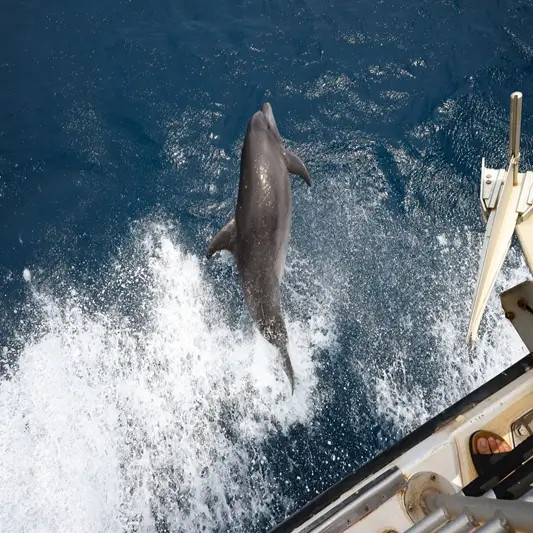
Sometimes dolphins use the moving water a vessel creates. Others may pass nearby without following it at all. From the deck, a brief encounter doesn't necessarily reveal where an animal was going or why it changed direction.
Wave-riding can offer a physical benefit, and play is another explanation researchers have discussed. No single motive has been demonstrated for every dolphin, species, or encounter.
What Is Dolphin Bow-Riding?
Bow-riding happens when a dolphin swims in the pressure wave at the front of a moving vessel. The hull pushes water aside, creating a flow the animal can use. Riding a wave behind the boat is more accurately described as wake-riding.
Once positioned in suitable moving water, a dolphin may need fewer swimming movements to keep pace. Think of an animal using the boat-generated wave, not the boat pulling it along and not a dolphin deliberately clearing a route for people.
What Research Can Tell Us
A 2024 study published in Scientific Reports observed wild dusky dolphins off Kaikōura, New Zealand, using breathing rates as an indirect measure of energy expenditure. At speeds above 4 meters per second, bow-riding dolphins had breathing rates 45% lower than freely swimming dolphins. The finding supports an energy-saving benefit under the conditions studied.
The study doesn't establish one universal reason for bow-riding or measure every species found around Maui. Play remains a possibility in the broader discussion. Understanding the behavior also isn't a reason to maneuver toward dolphins or try to create an encounter.
What A Wild Dolphin Sighting Means In Maui
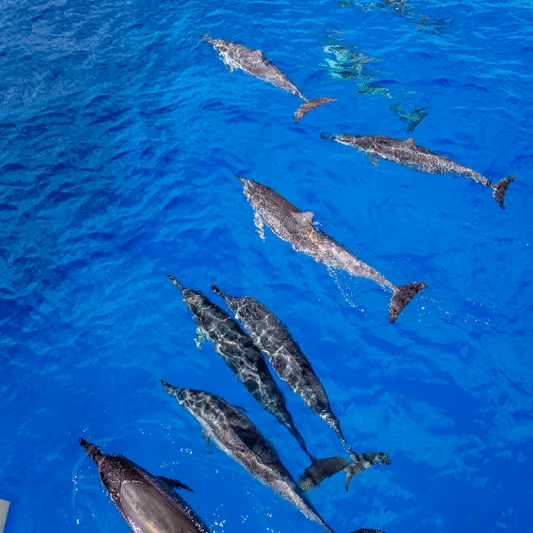
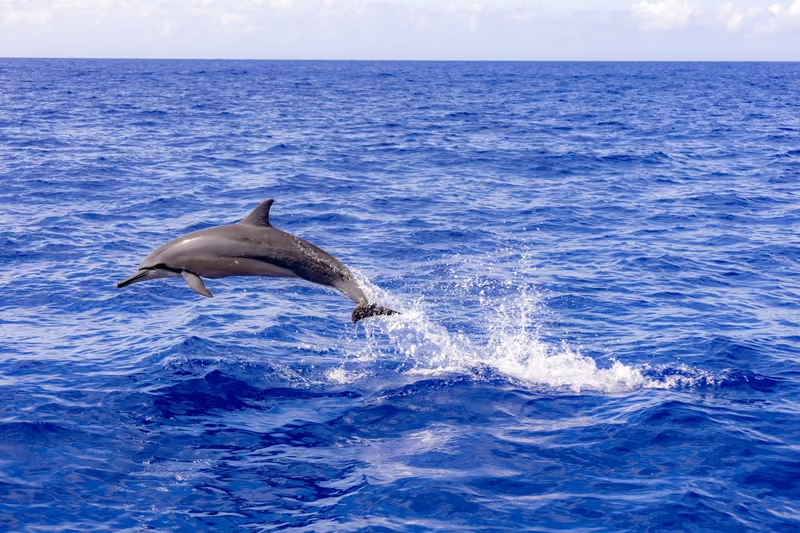
In Maui, a dolphin sighting offers a glimpse of wild animals in their natural habitat. It may become the moment everyone talks about over lunch.
To help you identify them, our Maui Dolphins guide compares spinner, bottlenose, and spotted dolphins.
On our Maui Snorkeling trips, the crew may point out dolphins encountered naturally while traveling to or from a snorkeling destination. The captain chooses the route around ocean conditions, safe vessel operation, and wildlife-viewing rules. A dolphin report doesn't override those decisions, and sightings aren't guaranteed. Our guide to how our captains choose the day's snorkeling destination explains what goes into those calls.
How To Watch Maui Dolphins Responsibly
NOAA recommends viewing dolphins from at least 50 yards away. Watch from the boat or shore, use binoculars or a camera's zoom, and don't feed, touch, chase, or encourage interaction.
Hawaiian spinner dolphins have an additional federal rule: people and vessels must not swim with, approach, or remain within 50 yards of them, subject to specific exceptions. The rule covers waters within two nautical miles of the Main Hawaiian Islands and designated waters between Maui, Lānaʻi, and Kahoʻolawe.
What If Dolphins Approach The Boat?
If Hawaiian spinner dolphins approach an underway vessel, it may continue normal navigation without engaging or pursuing them. That exception doesn't permit steering into their path or encouraging bow-riding. Stay aboard and follow the crew's directions.
If a person unexpectedly approaches in the water, avoid engaging or pursuing the dolphins and take immediate steps to move away. Don't treat an animal's approach as consent to swim together.
Uninterrupted space matters, particularly for spinner dolphins resting during the day. Our Eco-Friendly Snorkeling In Maui guide explains how that same respectful approach carries over to reef visits.
Final Thoughts: A Little Luck, A Lot Of Wonder
The dolphin's place in maritime folklore comes from a hopeful idea: out on a vast sea, help or companionship might appear when you least expect it. Ancient stories made that idea memorable; real sightings keep it easy to appreciate.
You don't need a promise of protection to feel fortunate. Enjoy the story, respect the animal, and let an unexpected glimpse remain exactly that: an extraordinary part of an ordinary wild day.
Sources & Updates
These references cover maritime folklore, ancient narratives, dolphin behavior, and responsible wildlife viewing.
-
Maritime Beliefs:
The Library of Congress's guide to maritime folklife
explains the role of traditional beliefs in seafaring culture.
-
Dolphin Good Luck:
USC's Digital Folklore Archives
records a 2019 account of the dolphin good-luck belief being passed down within a family.
-
Ancient Narratives:
Translations published by Harvard's Center for Hellenic Studies include
Herodotus's Histories, Book 1, sections 23–24,
which recounts Arion's dolphin rescue, and the
Homeric Hymn to Apollo,
which describes Apollo taking a dolphin's form.
-
Bow-Riding Research:
Fiori and colleagues' 2024 study, “Energetic savings of bow-riding dolphins,”
examines breathing rates in wild dusky dolphins as an indirect measure of energy expenditure, supporting an energy-saving benefit under the conditions studied.
-
Spinner Dolphin Rules:
NOAA's questions and answers
and
50 CFR § 216.20
cover distance, geographic scope, and exceptions.
-
Responsible Viewing:
NOAA's Hawaiʻi viewing guidelines
explain how to observe marine wildlife without disturbance.