Nenuʻe Fish In Maui: Hawaiian Chub Identification And Reef Role
November 6th, 2026
| Marine Life
Written by Maui Snorkeling, operating tours to Molokini Crater, Turtle Town, and Coral Gardens from Māʻalaea Harbor since 1985. Tours are led by USCG-licensed captains aboard a USCG-inspected passenger vessel.
Last updated November 6, 2026
Quick Answer
Nenue (nenuʻe) are algae-eating sea chubs found around Maui’s rocky and coral reefs. Look for a deep oval body, small mouth, forked tail, and often a school of gray or silvery fish. Some individuals are yellow or patchy. Several species share the name, so a snorkeling photo may identify a chub without establishing its exact species.
Main takeaways:
Identification: Compare body shape, tail, markings, and behavior rather than relying on silver coloration alone.
Species: Several chubs share the name nenuʻe, so a precise scientific identification may need expert review.
Colors: Yellow patches and dark patterns don't automatically establish a different species, sex, or social role.
Food: These browsers eat larger seaweeds, contributing to the balance between algae and coral.
Habitat: Look within suitable rocky and coral-reef areas without following fish into surge or rough water.
Viewing: Leave schools undisturbed, keep clear of coral, and treat every sighting as a bonus.
A school of silver fish turns above the reef, and suddenly the whole group catches the light. They might not have a butterflyfish's bold pattern or a wrasse's bright colors, but these fish are worth a second look. Meet nenuʻe, the chubs whose everyday meals are part of the reef's bigger story.
Nenuʻe fish in Maui are a group of similar-looking sea chubs, not one species with a single dependable color. Most look gray or silvery, yet an unusually yellow individual or a dark, spotted fish can make identification more interesting.
Here's how to recognize the group, understand those changing appearances, and notice what the fish are doing without needing a scientific name for every photograph.
What Is A Nenuʻe Fish?
Nenuʻe is a Hawaiian name used for several sea chubs in the genus Kyphosus, family Kyphosidae. You'll also encounter the names chub, sea chub, and rudderfish. In Hawaiian-language references, spellings and related names include nenue, nenuwe, and enenue.
These are marine fish, not the freshwater chubs found in mainland rivers. Think of a sturdy reef fish with an oval body, a relatively small mouth, and a forked tail. They're often seen in groups, and algae feature prominently in their diet.
Learning the group is a useful first step. You can recognize a nenuʻe and appreciate its behavior even when the exact species remains uncertain.
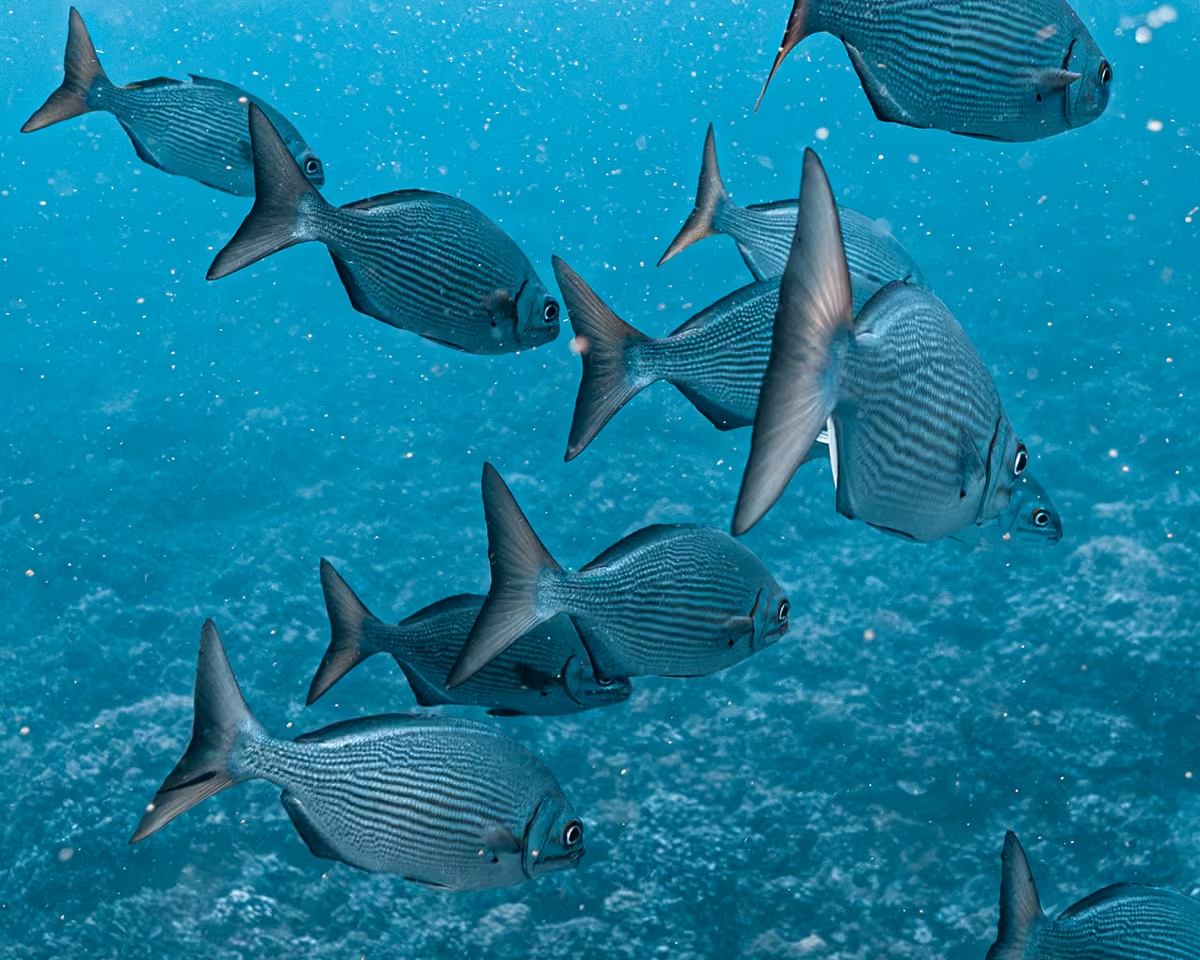
A side view makes the nenuʻe’s small mouth, deep oval body, and forked tail easier to recognize.
How To Identify Nenuʻe While Snorkeling
Start With The Outline
Look for a deep, oval or football-shaped body rather than a long, narrow profile. The head is relatively blunt, and the tail has a clear fork. A side view shows these features better than a fish swimming directly toward you.
Compare several clues together. A silver body alone won't distinguish a chub from every other reef fish, and a passing school can move too quickly for a confident identification.
Look For Subtle Lines And A Lighter Belly
Typical nenuʻe descriptions include a gray-brown upper body with bluish reflections and a lighter underside. Narrow lines can follow the rows of scales along the sides. They may be much easier to see in a photograph than during a quick underwater pass.
A wide view helps you notice schooling behavior. Then choose one fish to study: body outline, tail, markings, and whether it's passing above the reef or feeding near the bottom. Our Maui Tropical Fish Guide helps compare other possibilities when the identification isn't obvious.
Nenuʻe Identification At A Glance
Combine several visible clues to recognize a chub, then keep the species label broad when the photograph doesn't show enough detail.
Feature
What To Look For
What Not To Assume
Body Shape
Deep, oval body, relatively blunt head, small mouth, and forked tail.
One feature alone distinguishes a chub from every other reef fish.
Typical Color
Gray or silvery sides, a darker upper body, and subtle lengthwise markings.
Every silver fish belongs to the same species.
Yellow Or Patchy Color
Irregular yellow areas or an unusually yellow individual among other chubs.
Color alone identifies a separate species, sex, or school leader.
Dark And Spotted Pattern
A dark body with contrasting pale spots.
A single photograph proves disease, spawning, or the cause of a color change.
Schooling
Groups moving above rocky or coral-reef habitat.
Every fish in the group has the same species identity.
Feeding
Natural browsing on seaweed attached to reef surfaces.
Every fish photographed near algae is actively eating it.
Note: Use “nenuʻe” or “chub” when the exact species is uncertain. A precise scientific label should follow verification, not replace it.
Are All Nenuʻe The Same Species?
No. Several similar chubs share the name.Hawaiʻi's herbivore management plan discusses highfin chub (Kyphosus cinerascens), lowfin chub (Kyphosus vaigiensis), Hawaiian chub (Kyphosus hawaiiensis), and other chubs together.
Their resemblance creates a challenge for snorkeling photographs. Fine differences in proportions, markings, and fins may not be visible, especially when the fish is angled away or partly hidden.
“Hawaiian chub” can also be confusing: a reader may use it broadly for chubs seen in Hawaiʻi, while a species account uses it specifically for K. hawaiiensis. Seeing a chub in Hawaiian waters doesn't establish that identification.
For an uncertain photograph, nenuʻe or chub is an informative label. It isn't a failed identification. It's better than giving a precise scientific name that the visible features don't support.
Why Do Some Nenuʻe Turn Yellow, Dark, Or Spotted?
Yellow And Patchy Individuals
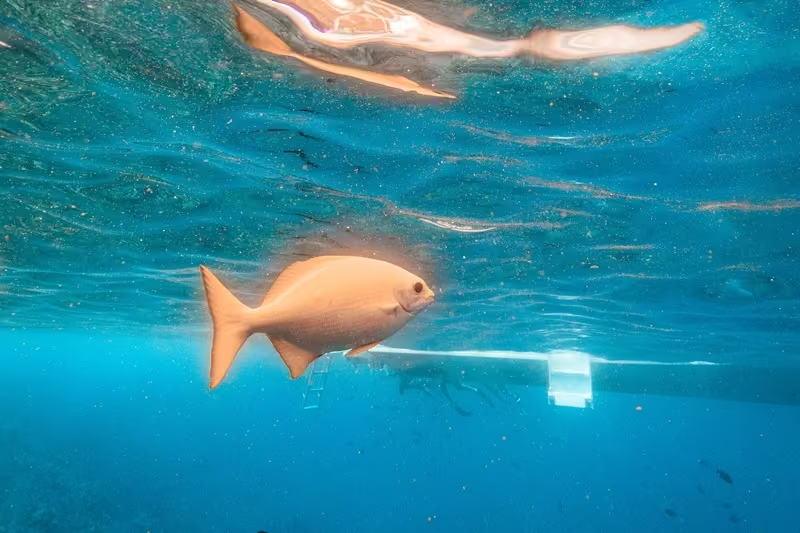
Some chubs have irregular yellow patches, and occasional individuals are almost entirely yellow. DLNR’s herbivore management plan also documents white and multicolored individuals. These unusual appearances don’t automatically make the fish a separate species.
A yellow nenuʻe in a gray school makes an eye-catching photograph, but the color alone doesn't reveal its age, sex, or role. Nor does it tell you whether the appearance changed recently. Enjoy the contrast without assuming you've found the school's leader.
A Dark Body With Pale Spots
Color can change with activity too. Hawaiʻi's management report describes nenuʻe becoming very dark with white spots when aroused during mating or browsing. That makes a dark, spotted appearance possible without it necessarily being a different kind of fish.
A single image won't establish what triggered the pattern. Don't interpret every spot as disease or every color change as spawning. Watching the same fish over time provides more context than comparing unrelated photographs.
A yellow nenuʻe swims beneath the surface. This unusual coloration alone doesn’t establish a separate species, sex, or leadership role.
Where Do Nenuʻe Live Around Maui?
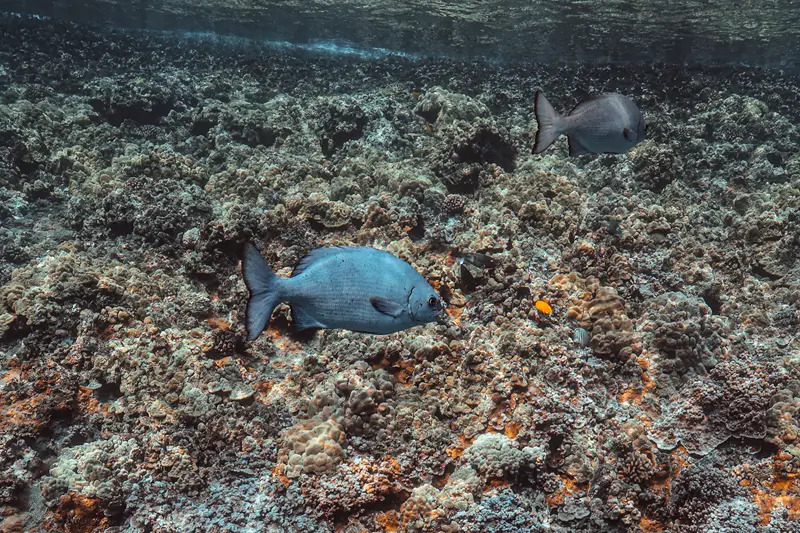
Rocky coastlines, coral reefs, and algae-covered hard surfaces provide nenuʻe habitat. Some use shallow, wave-washed areas, but their ability to feed in turbulent water doesn't make that water appropriate for a snorkeler.
Within a suitable snorkeling area, look above reef edges as well as along the bottom. A group cruising through open water can be easier to notice than individual fish feeding against a textured background.
Choose the outing around conditions and your swimming ability, then enjoy what appears. Don't follow a school into surge, around a headland, or beyond the crew's designated area to improve a photograph.
What Do Nenuʻe Eat?
Nenuʻe feed mainly on algae, including larger seaweeds called macroalgae. Their browsing connects the fish swimming above the reef with the growth attached to its surfaces. Diet varies among species; some also consume small invertebrates associated with the algae.
Look for natural feeding rather than offering food yourself. A fish turning toward a patch of seaweed gives you something to watch beyond its color. What seems like an ordinary lunch is also an ecological interaction.
A Digestive Partnership You Can't See Through Your Mask
Seaweed contains complex carbohydrates that aren't easy to break down. Research on Kyphosus gut microbes shows how bacteria help break down complex carbohydrates in seaweed.
That hidden partnership adds another layer to a familiar reef scene. The animal taking a bite isn't working alone: microorganisms inside its digestive system help turn seaweed into usable nourishment.
How Nenuʻe Help Maui's Coral Reefs
Nenuʻe are browsers, a particular kind of herbivore. Rather than treating every algae-eating fish as the same kind of “cleaner,” think about what it removes. Browsers eat larger pieces of seaweed, while other herbivores crop shorter growth or scrape reef surfaces.
Those different feeding roles can complement one another. By reducing algae that compete with corals, herbivores help maintain conditions that support coral growth and reef resilience. Our Maui Coral Reefs Guide explains the living habitat around them.
Seaweed itself isn't an enemy to eliminate. It's part of the ecosystem. The concern is excessive growth taking over space, not the mere presence of algae.
Why Herbivores Aren't A Cure For Bleaching
Algae browsing doesn't cool an overheated ocean or reverse every form of coral damage. Reef health also depends on water quality, climate, habitat, and other animals. Our Coral Bleaching In Maui guide explains that separate stress response.
Kahekili in West Maui provides a local example of herbivore protection. Within its Herbivore Fisheries Management Area, rules prohibit injuring, killing, possessing, or removing nenuʻe, along with specified other herbivores. That's a place-specific protection, not a claim that one fish can restore a reef by itself.
Hawaiian Names And Cultural Context
Hawaiian names aren't always one-to-one equivalents of scientific species names. The Wehewehe dictionaries list nenue and nenuwe, along with related names such as enenue and nanue. The entries preserve language usage rather than providing a modern underwater identification key.
That distinction helps when a local name, a fish guide, and a photograph don't line up neatly. Listen to the name being used in its setting instead of assuming every difference is a mistake.
The state herbivore report also records a traditional description of a yellow nenuʻe as the queen of the school. It separately notes that the unusual coloration hasn't been shown to carry a corresponding social or behavioral role. Cultural meaning and biological evidence can be respected without treating them as identical claims.
How To Observe Nenuʻe Responsibly
Give a school space to pass rather than trying to swim into its center. Don't feed, chase, touch, or corner fish. Keep your fins and loose equipment away from coral, and stay with your buddy.
For identification photos, aim for a whole side profile showing the head, tail, and fins. Add a wider habitat photograph when the view allows it. Keep the original colors believable; heavy editing can obscure the subtle markings you're trying to document.
Record the location and date afterward, and keep the label at “nenuʻe” when the exact species hasn't been verified. Our Eco-Friendly Snorkeling In Maui guide has more ways to enjoy the reef without disrupting it.
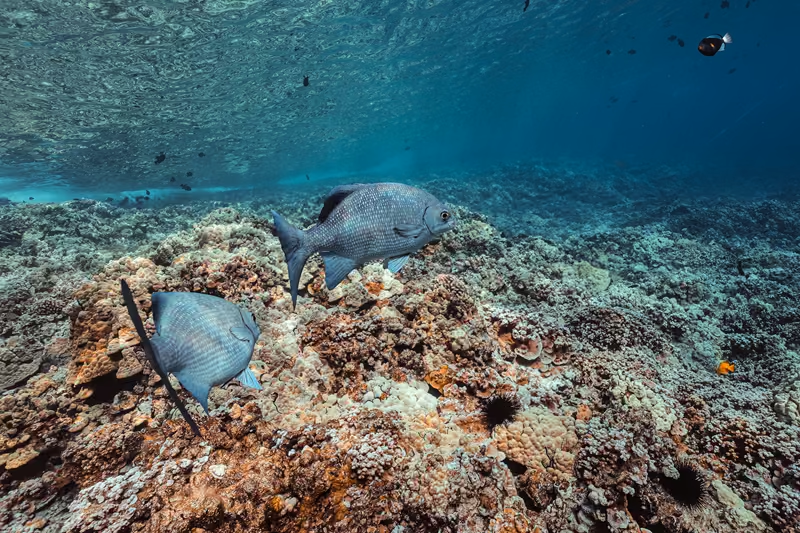
Two nenuʻe swim above a Maui coral reef, with black sea urchins visible among the coral below.
FAQs
Nenuʻe is a Hawaiian name used for several marine chubs, also called rudderfish. It doesn't identify just one species. These reef-associated fish feed mainly on algae, and closely related chubs can be difficult to distinguish in an underwater photograph.
No. A chub photographed in Hawaiʻi isn't automatically Kyphosus hawaiiensis. Several similar species share the name nenuʻe. Use the broader label unless clear features support a species identification and someone familiar with the group has verified it.
Yellow patches and nearly all-yellow individuals are documented color variations. That appearance alone doesn't explain the underlying cause or prove a separate species, sex, or leadership role. Compare the body shape and other features rather than identifying a fish by yellow color alone.
They're primarily algae eaters, especially browsers of larger seaweeds, rather than coral predators. Their feeding can reduce algae competing with coral for space. Different chub species have somewhat different diets, so not every bite involves exactly the same food.
Hawaiʻi's marine-fish directory gives a general size range of 12–20 inches for nenuʻe, while its older fish guide describes individuals reaching about 24 inches. These are group-level references, not a fixed adult size or a rule for identifying every species.
Look within suitable rocky and coral-reef habitat, including water above the reef where groups may pass. No beach or tour stop guarantees a sighting. Stay within your planned snorkeling area rather than following fish into surge, deeper water, or an uncertain return route.
Don't feed fish to create a sighting or photograph. Watch their natural behavior and let them pass without chasing or surrounding them. At Kahekili, introducing food or attractants is also restricted, with a specific exception for fishing for permitted marine life.
Ready to snorkel Maui?
Snag your spot on a Maui Snorkeling Tour! Make your ocean day easy with snorkel gear, food, crew support, and simple online booking.
5-Hr Morning Adventure: Molokini Crater Snorkeling Tour
3-Hr Afternoon Reef Trip: Maui Afternoon Snorkeling Tour
Nenuʻe don't need neon colors to make a snorkeling day memorable. A school turning in the light, a fish browsing seaweed, or an unusual yellow individual gives you something new to notice.
Start with the shape, stay curious about the behavior, and let uncertain species names stay uncertain. Once you understand what these chubs eat and how they fit into the reef, a passing school becomes much more than a group of silver fish.
Sources & Updates
These references distinguish shared names, identification clues, color variations, and reef roles. Group descriptions don't confirm a photograph's exact species. Historical reports aren't current Maui population estimates.