
A patch of sand lifts off the bottom, glides a short distance, and becomes a fish. That's the surprise of spotting a peacock flounder: the animal may have been in front of you all along, hidden by its shape and changing pattern.
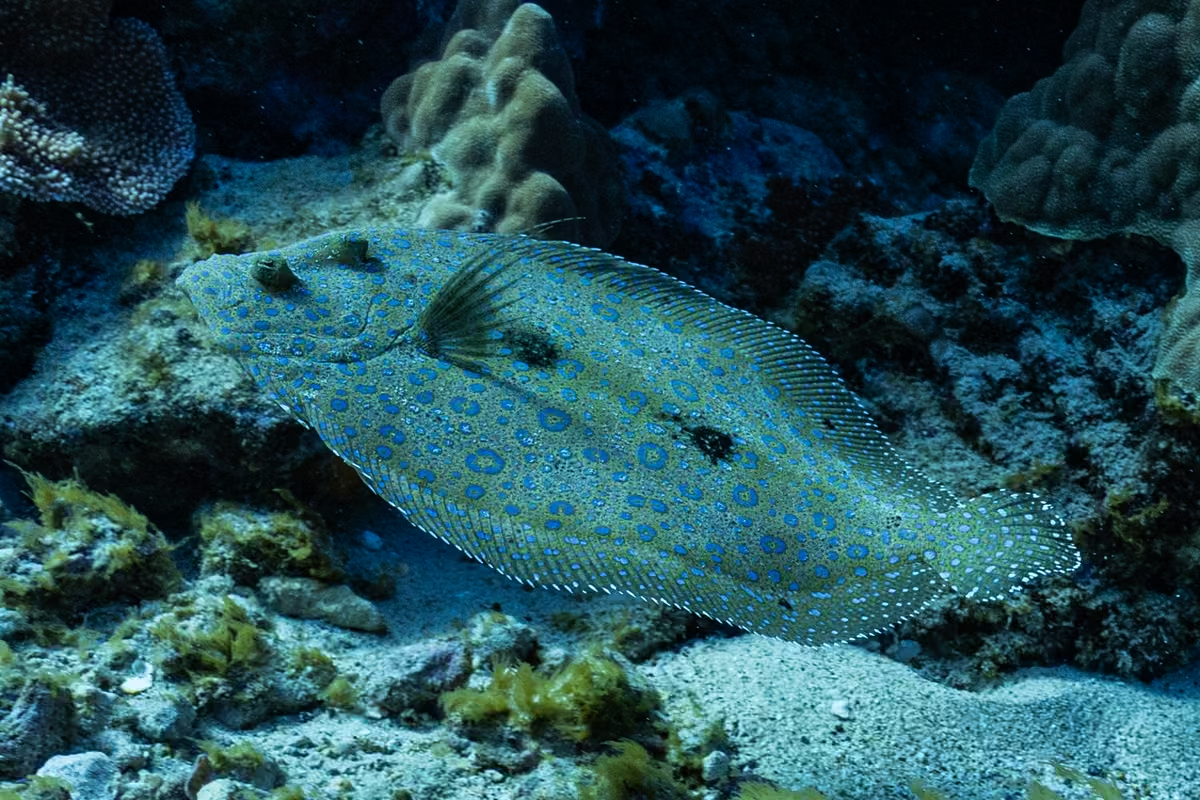
The peacock flounder in Maui is Bothus mancus, also called the flowery flounder. Look for a flat oval body, blue spots or rings, and both eyes on the upper-facing left side. It changes its pattern and can partly bury itself in sand. This bottom-dwelling hunter uses sand, rubble, rock, and reef edges, not just coral habitat. Observe without touching, uncovering, or chasing it, and treat a sighting as a bonus.
A patch of sand lifts off the bottom, glides a short distance, and becomes a fish. That's the surprise of spotting a peacock flounder: the animal may have been in front of you all along, hidden by its shape and changing pattern.
Start with the shape and eyes, then look for markings and movement. The background color can change without the fish becoming a different species.
| Feature | What To Look For | Helpful Interpretation |
|---|---|---|
| Body Outline | A broad, flattened oval close to the seafloor, with a distinct tail. | Find the outline before looking for bright colors. |
| Eyes | Two raised eyes on the upper-facing side. | The adult rests on its right side, with its left side facing upward. |
| Markings | Pale blue or whitish spots, broken rings, darker speckles, and larger dark blotches. | Pattern and contrast vary. Compare several features rather than color alone. |
| Fin Edges | Long fins bordering the body, sometimes moving in small traveling waves. | The fish may be crawling along the bottom rather than swimming above it. |
| Habitat | Sand, rubble, bare rock, and the spaces around reef features. | Don't limit your attention to living coral. |
| Resting Or Feeding | A still or partly buried fish with its eyes exposed. | Stillness may be part of ambush hunting, not evidence that the fish is asleep. |
| Maximum Size | Up to about 42 cm (16.5 inches), according to the Australian Museum. | This is a maximum, not a typical sighting size. |
Note: These clues support identification from a comfortable viewing position. Never uncover, handle, or chase a fish to check its features.
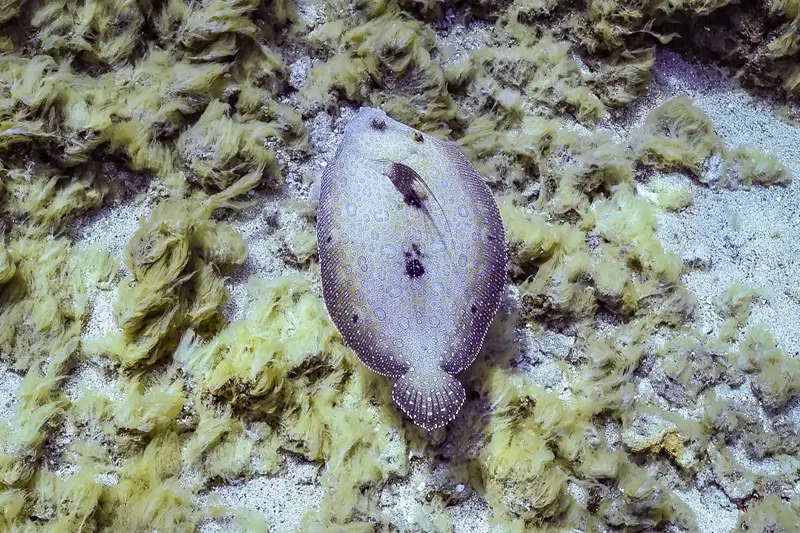
Look for a broad oval body lying close to the bottom, with long fins bordering its edges. The tail is distinct from the surrounding fringe. From above, the fish may resemble a patterned leaf spread across the sand.
Rather than scanning only for a bright blue fish, look for an outline that interrupts the bottom's natural texture. Movement can reveal the edge of a body that was almost impossible to separate from its background.
Both eyes project from the upper-facing side. Across the head and body, pale blue or whitish spots can form rings and broken circles. Darker speckles and several larger dark blotches add to the pattern, but their prominence varies.
A male may have an especially long pectoral fin on the eyed side, along with wider spacing between the eyes. Those finer features are useful in a clear photograph, but they aren't necessary for enjoying a first identification.
Compare the whole fish, not just one spot. Our Maui Tropical Fish Guide helps put that unusual flat profile alongside the more familiar shapes swimming above it.
The peacock flounder found in Hawaiian waters is Bothus mancus, also called the flowery flounder. It belongs to Bothidae, the lefteye flounder family. Adults spend much of their time close to the seafloor, lying on their right side with their left side facing upward.
It's native to Hawaiʻi but also occurs widely across the tropical Indo-Pacific. Calling it only a coral-reef fish misses much of its habitat: sand, rubble, bare rock, and the transitions between these surfaces are important parts of its world.
One naming detail matters when comparing pictures. The Atlantic species Bothus lunatus is also called peacock flounder. A Caribbean photograph may show that different species, even when the common name matches. For Maui, check that the reference identifies Bothus mancus.
A peacock flounder doesn't begin life with both eyes together. Like other flatfishes, it starts as a tiny swimming larva with eyes on both sides of its head. Its early life looks very different from the bottom-dwelling adult.
During a developmental transformation called metamorphosis, the right eye shifts across the head toward the left. As the fish takes up its sideways life, both eyes end up on the side facing the water above.
That arrangement lets it lie low while keeping both eyes clear of the bottom. What looks unusual beside an upright fish makes sense for an animal that spends so much time resting on one side.
The eye migration is a growth-stage change, not something the adult repeats every time it changes color. Nor is the fish resting on its belly like a ray. The surface you see is its left side, which has become the practical upper side of its body.
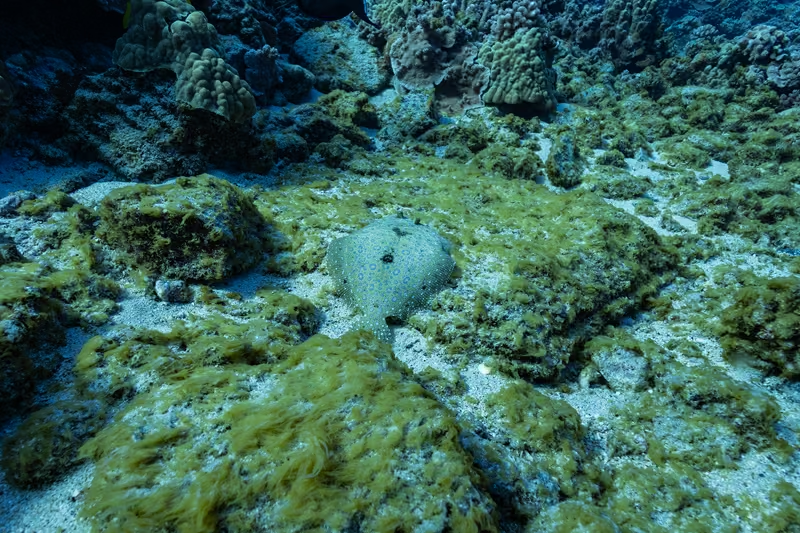
Camouflage involves both the fish's skin and the way it uses its surroundings. A peacock flounder can adjust its coloration and pattern to resemble the bottom. Specialized pigment cells, called chromatophores, help create these changes in appearance.
Shifting the contrast between light and dark areas makes the body's outline harder to follow against sand, rock, or mixed rubble. The blue markings can remain visible when you know where to look, even while the overall fish blends into the scene.
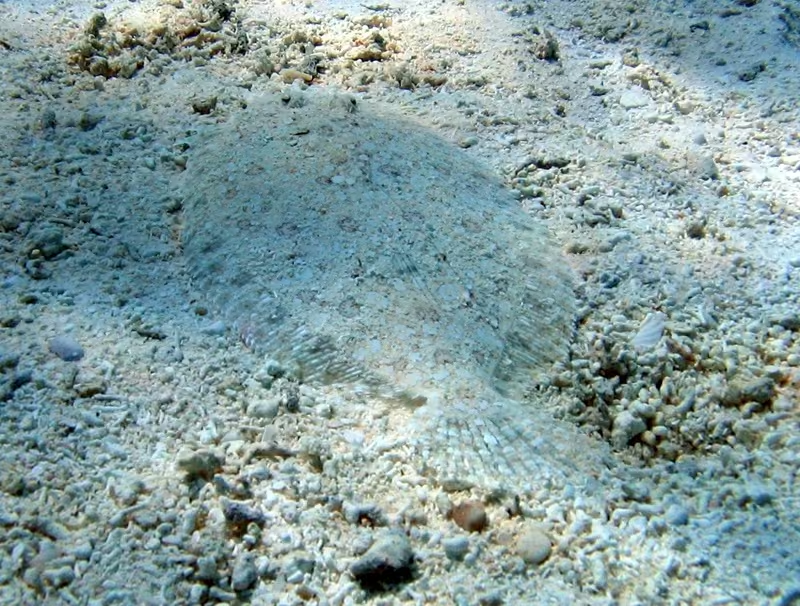
The fish has another option on loose sand: partially covering itself while leaving its eyes exposed. Skin camouflage and a layer of sand are different ways to become less conspicuous, and a flounder may use both.
Don't expect every individual to look identical to a brightly lit reference photo. Background, lighting, and the fish's current pattern all affect what you see. An almost invisible fish and a vividly spotted one can be the same species.
The best part is noticing the disguise yourself. Once you've found the eyes, trace the outline visually and see how much of the fish you initially mistook for seafloor. There's no need to chase it onto a different background to make the point.
Watch the body margins when the fish moves. It can swim away from the bottom, but it also has a subtler way to travel: fin crawling. Sections of the long dorsal and anal fins work against the bottom, moving the fish along while much of its body stays relatively still.
Researchers have documented this movement in several flatfish species, including Bothus mancus. The fin rays act together in traveling waves. The result can look like a small, patterned carpet creeping across the sand rather than a fish swimming with obvious tail beats.
Swimming and crawling are different movements, so don't assume every change in position is the same behavior. A short video may reveal the moving fin edges more clearly than a still photograph. Enjoy whatever movement occurs naturally rather than prompting the fish to leave its resting place.
Peacock flounders eat small fish and crustaceans, including shrimp and crabs. Their camouflage helps them approach a meal unnoticed or wait until prey comes within reach. A quick dart can replace what looked like complete stillness a moment before.
Hawaiian field research documented small fish in their diet and daytime feeding. That makes a motionless flounder a potential hunter, not necessarily a sleeping one. The same concealment that helps it catch prey can also hide it from larger predators.
This feeding role differs from the algae browsing you might notice elsewhere on the reef. A sand patch can contain feeding opportunities even when it looks empty beside a colorful coral head.
You probably won't see a full hunt during every encounter. Watching the eyes, resting posture, and occasional repositioning can be interesting enough. Don't offer food or stir the bottom to create action for the camera.
Our peacock flounder photos show how differently this fish can blend into the surrounding bottom. In the close-up, the blue rings and two raised eyes are easy to recognize. The overhead photograph reveals the broad oval outline and larger dark blotches. In the wider reef scene, that same flat shape is harder to separate from the sand and algae-covered rock beside the coral.
When snorkeling around Maui, take a second look at the spaces between reef features. Slowly scan a small patch for raised eyes, a curved fin edge, or blue rings that interrupt the surrounding texture. Once you notice one feature, follow the outline with your eyes. These photographs give you several details to look for, even when the whole fish isn’t immediately obvious.
Both have blue markings, but their bodies tell different stories. A peacock flounder is broad, flat, and usually close to the bottom, with both eyes on its upper-facing side. A peacock grouper has a thick, upright swimming profile and an eye on each side of its head.
The shared name doesn't make them the same kind of fish. Our peacock grouper guide covers roi and includes a side-by-side comparison. Use shape and eye position before trying to identify them from blue spots alone.
Give the fish room to remain hidden. Don't touch it, uncover it, surround it, or keep following after it moves away. A resting flounder isn't an invitation to test how close you can get before it swims.
Keep your hands, fins, and equipment clear of the bottom. Kicking up sand can obscure the animal, disturb its surroundings, and spoil the view for your buddy. Don't kneel on sand or brace against coral to steady a photograph.
For identification, include the whole outline and, when naturally visible, both eyes. A wider habitat shot helps show why the camouflage works. Keep the colors believable when editing, rather than increasing saturation until the markings look unlike the original scene.
Our Maui Snorkeling Photography Guide covers camera habits, while Eco-Friendly Snorkeling in Maui explains low-impact viewing. Keep checking your buddy and position, and leave the close-up behind if getting it would disturb wildlife or exceed your swimming comfort.
Few fish change the way you look at the bottom quite like a peacock flounder. Once a patch of sand reveals eyes, fins, and blue rings, the apparently empty spaces around the reef become much more interesting.
Remember the flat outline, paired eyes, and changing pattern. Then enjoy the encounter on the fish's terms. A glimpse of camouflage working naturally is a better memory than a fish chased into view.
This guide covers Bothus mancus, not the Atlantic species sharing its common name. References support identification, development, movement, and feeding; they don't guarantee sightings or establish conditions at a snorkeling site.
© 2026 Maui Snorkeling | Sitemap | Disclaimer | Privacy Statement | Cookie Policy