Porcupinefish In Maui: Spot-Fin Identification, Behavior, And Snorkeling Tips
July 24th, 2026
| Marine Life
Written by Maui Snorkeling, operating tours to Molokini Crater, Turtle Town, and Coral Gardens from Māʻalaea Harbor since 1985. Tours are led by USCG-licensed captains aboard a USCG-inspected passenger vessel.
Last updated August 27, 2026
Quick Answer
Porcupinefish in Maui include the spot-fin porcupinefish, scientifically known as Diodon hystrix. Look for a broad head, large eyes, long fold-down spines, and many small black spots covering both the body and fins. These shy, mostly nocturnal reef fish often rest beneath ledges or inside reef holes during the day. Don’t touch, chase, corner, or deliberately frighten one into inflating.
Main takeaways:
Best ID Clue: Small black spots continue across the body, dorsal fin, anal fin, and tail
Where To Look: Shaded reef holes, caves, crevices, rocky ledges, and protected areas close to the bottom
Typical Size: Adults are commonly around 16 inches long, but the species can reach approximately 3 feet
What They Eat: Sea urchins, snails, hermit crabs, and other hard-shelled reef animals
Defense: They swallow water and inflate, causing their folded spines to stand outward
Snorkeling Rule: Never try to make a porcupinefish puff up for a photograph
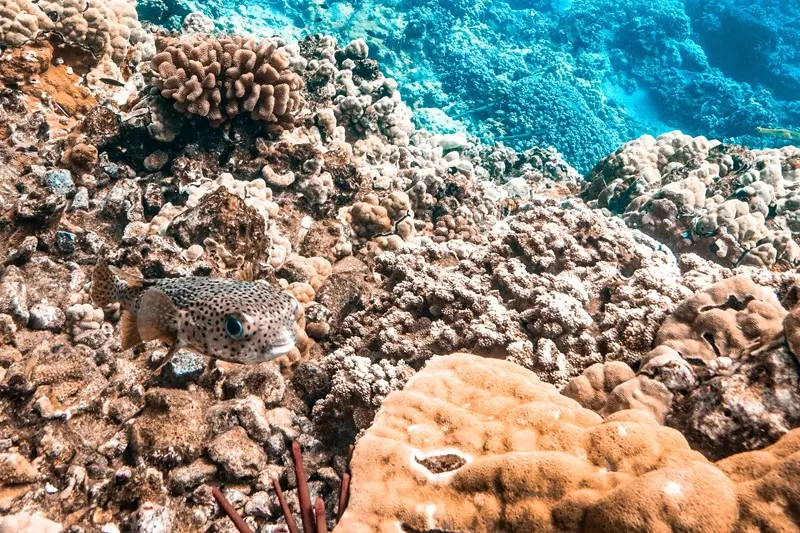
If your Maui underwater photos include a wide-eyed fish covered in tiny black spots, you may have photographed a spot-fin porcupinefish. It may look permanently surprised, slightly grumpy, or suspicious about why you brought a camera into its living room. 🐡
The spot-fin porcupinefish, scientifically known as Diodon hystrix, is a large reef fish with a broad head, beak-like mouth, long fold-down spines, and small black spots covering its body and fins. It’s also called the spotted porcupinefish, giant porcupinefish, or simply porcupinefish.
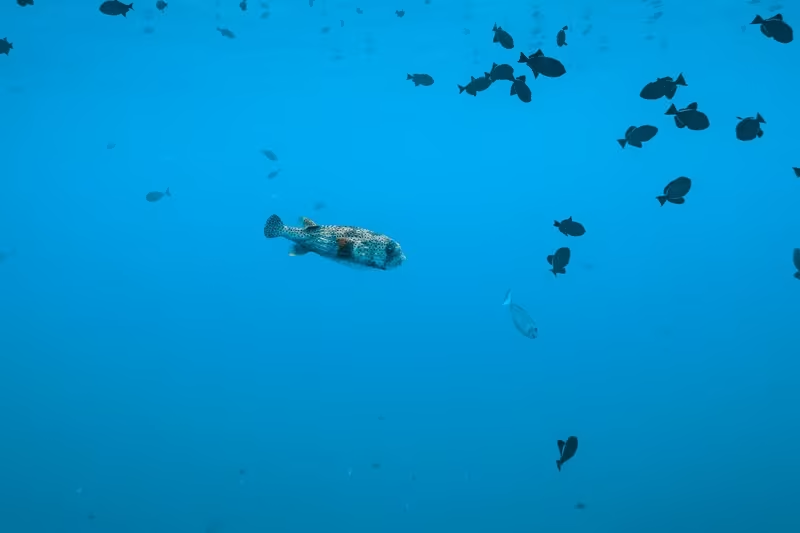
These fish aren’t always easy to notice. They’re generally more active at night and often spend daylight hours resting inside reef holes, beneath ledges, or near dark crevices. Spotting one while snorkeling can feel like discovering a secret reef resident hiding in plain sight.
This guide explains how to identify a porcupinefish in Maui, how it differs from other puffer-like fish, where to look, what it eats, why it inflates, and how to photograph one without causing stress.
What Is A Spot-Fin Porcupinefish?
The spot-fin porcupinefish belongs to the porcupinefish family, Diodontidae. It’s part of the larger Tetraodontiformes order, which also includes true pufferfish, triggerfish, boxfish, filefish, and several other unusually shaped reef fish.
Its scientific name is Diodon hystrix. The genus name refers to its two powerful dental plates, one in the upper jaw and one in the lower jaw. Together, they create a strong beak that can crush the shells of sea urchins, snails, hermit crabs, and other hard-shelled animals.
FishBase records the Hawaiian names kōkala and ʻoʻopu-kawa for this species. You may also see English names such as spotted porcupinefish, spot-fin porcupinefish, black-spotted porcupinefish, or giant porcupinefish.
Because common names overlap between several similar fish, the scientific name is the clearest way to confirm the species.
Generally solitary and nocturnal, with adults often resting in protected reef spaces during the day
What they eat
Sea urchins, marine snails, hermit crabs, mollusks, and other hard-shelled reef animals
Feeding tool
Strong fused dental plates form a beak capable of crushing thick shells and hard external skeletons
Why they inflate
Inflation makes the fish larger and causes its long spines to project outward, making it more difficult for a predator to swallow
Similar species
The longspined porcupinefish, Diodon holocanthus, usually has larger dark blotches and fins without the same dense pattern of small black spots
Porcupinefish vs pufferfish
Porcupinefish belong to Diodontidae and have long obvious spines. True pufferfish belong to Tetraodontidae and generally lack the same long external spines
Are they dangerous?
They aren’t aggressive toward snorkelers, but their sharp spines and powerful beak mean they should never be touched, cornered, or handled
Food safety
FishBase lists the species as poisonous to eat. Snorkelers should leave every wild porcupinefish in the reef
Conservation status
FishBase currently displays a global Least Concern classification based on the cited IUCN assessment
Photography tip
Photograph the full side profile and spotted fins from outside the fish’s shelter. Don’t chase or provoke it into inflating
Snorkeling tip
Float quietly, keep your fins controlled, leave the fish an open exit, and never put your hands inside reef holes
Note: Porcupinefish sightings aren’t guaranteed during a Maui snorkel. Check the fins before confirming your photo identification because several related porcupinefish can look similar underwater.
How To Identify A Spot-Fin Porcupinefish
The spot-fin porcupinefish has several useful identification clues. The easiest one is right in its name: look closely at the fins.
Small Black Spots: Numerous small black spots cover the upper body and continue across the dorsal, anal, and tail fins.
No Large Dark Blotches: The body may have subtle shading, but it lacks the large, obvious dark patches found on some similar porcupinefish.
Broad Head: The head is wide and rounded rather than narrow or pointed.
Large Eyes: Its prominent eyes help it navigate and find food during its more active nighttime hours.
White Underside: The belly is generally much lighter than the spotted upper body.
Long Spines: The head and body are covered in long spines that usually lie folded backward when the fish is relaxed.
Small Rear Fins: The dorsal and anal fins sit far back on the body near the tail.
No Pelvic Fins: Unlike many familiar reef fish, porcupinefish don’t have pelvic fins beneath the body.
When reviewing your photos, zoom in on the fins. Small black spots across the fins are one of the best clues that you photographed Diodon hystrix.
Similar Porcupinefish Species In Maui
Spot-fin porcupinefish can be confused with longspined porcupinefish, but their markings make them easier to tell apart once you know what to look for.
Identification Clue
Spot-Fin Porcupinefish
Longspined Porcupinefish
Scientific Name
Diodon hystrix
Diodon holocanthus
Body Markings
Covered with numerous small black spots across most of the body.
Usually has larger dark blotches with fewer small spots.
Fin Markings
Small dark spots continue across the tail and other fins.
Fins are generally clearer and lack the same dense spotting.
Overall Pattern
Has an evenly freckled or finely spotted appearance.
Has a patchier appearance created by larger dark markings.
Head And Body Shape
Often appears broad-headed with a thick, rounded body.
Usually appears slightly narrower, with especially noticeable long spines.
Best Identification Clue
Look for small black spots continuing onto the fins.
Look for larger body blotches and fins without dense spotting.
The easiest way to identify a spot-fin porcupinefish is to look closely at its fins. If the small black spots continue across the tail and fins, it’s likely a spot-fin porcupinefish.
Porcupinefish Vs Pufferfish
People often use “porcupinefish” and “pufferfish” as though they mean exactly the same thing. They’re close relatives, and both can inflate, but they belong to different families.
Porcupinefish belong to the family Diodontidae. They have long, obvious spines covering the head and body. Those spines lie flat when the fish is relaxed and project outward when it inflates.
True pufferfish in Mauibelong to the family Tetraodontidae. They usually have smoother bodies or much shorter spines that aren’t as obvious as those of a porcupinefish.
Both groups have strong beak-like teeth, rounded bodies, small fins, and the ability to inflate when threatened. Calling a porcupinefish a pufferfish in casual conversation isn’t unusual, but “spot-fin porcupinefish” is the more precise identification for Diodon hystrix.
True pufferfish in Maui belong to the family Tetraodontidae. They usually have smoother bodies or much shorter spines that aren’t as obvious as those of a porcupinefish.
Where Do Porcupinefish Live Around Maui?
Spot-fin porcupinefish live around tropical and subtropical coral and rocky reefs. Adults often stay close to caves, reef holes, crevices, ledges, and other structures that provide daytime shelter.
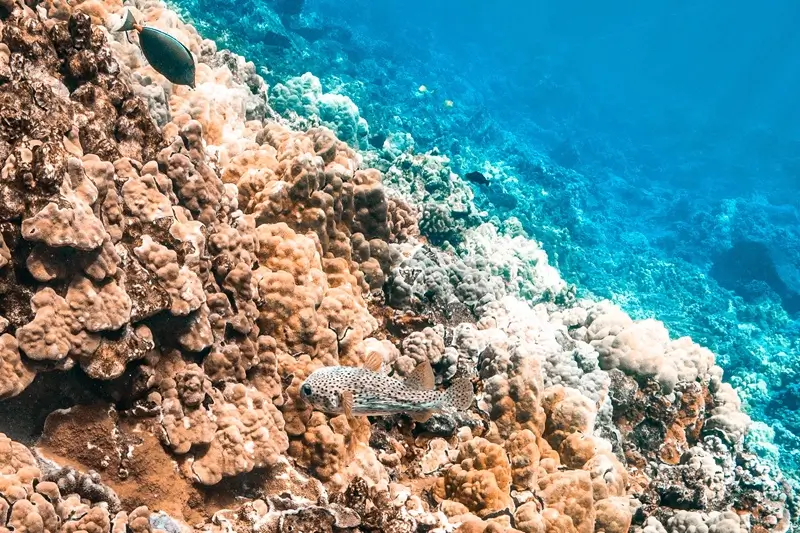
On Maui, don’t spend the entire snorkel looking only into open blue water. Slowly scan the shaded spaces beneath reef ledges and around larger coral or lava formations. You may see a broad face, one large eye, or the front half of a spotted fish peeking from the darkness.
Healthy reef areas around Maui may provide suitable habitat, including reefs visited during boat tours and calm shore-snorkeling locations. No particular Maui beach, reef, or tour route guarantees a porcupinefish sighting.
Spot-fin porcupinefish are generally solitary and nocturnal. They’re more active after sunset, when they leave shelter to search for hard-shelled prey.
During the day, resting beneath a ledge offers shade and protection. The fish’s tan color and spotted pattern can blend surprisingly well with reef shadows, sand, rubble, and textured rock.
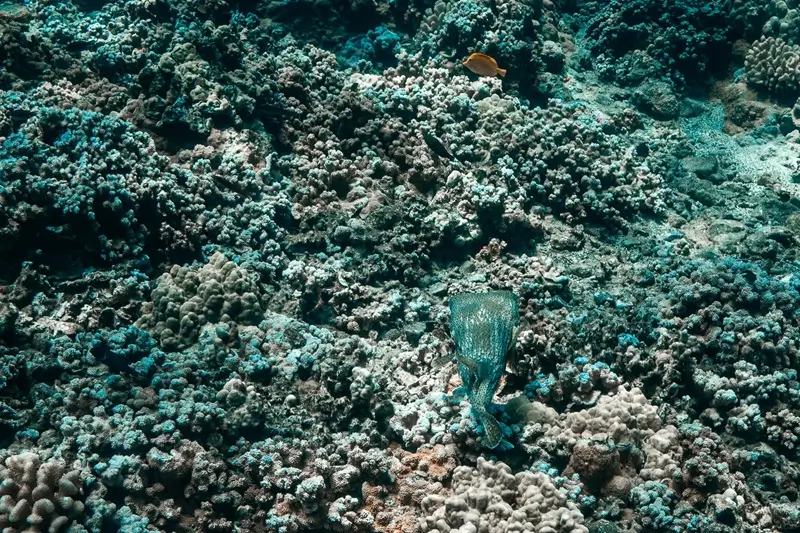
This behavior also explains why snorkelers sometimes swim directly over a porcupinefish without noticing it. The fish may remain nearly motionless, moving only its pectoral fins or watching the passing snorkeler with one very large eye.
Don’t reach into a hole or place your camera inside a crevice. Watch from outside the shelter and allow the fish to decide whether it remains, moves deeper inside, or swims away.
What Do Spot-Fin Porcupinefish Eat?
Spot-fin porcupinefish feed on hard-shelled reef animals. Their diet includes sea urchins, marine snails, hermit crabs, mollusks, and other armored invertebrates.
Their jaws contain powerful fused dental plates that act like a heavy-duty reef nutcracker. These plates help them crush shells and other protective structures that many smaller predators can’t handle.
Bishop Museum research examining the stomach contents of Diodon hystrix found remains from numerous gastropod and hermit-crab species. The study described this porcupinefish as one of the tropical reef’s strongest shell-crushing predators.
That friendly-looking mouth is serious equipment. It isn’t built for smiling at underwater cameras, even though it does a convincing impression.
Why Do Porcupinefish Puff Up?
A porcupinefish inflates as a defense against predators. When threatened, it takes in water and expands, becoming larger and rounder.
As the body expands, the long spines that normally rest against the fish project outward. The result is a large, spiny ball that’s much harder for a predator to bite or swallow.
Inflation isn’t a performance, a party trick, or something a snorkeler should try to trigger. It means the fish believes it may be in danger.
Photos of inflated porcupinefish may look dramatic, but the most responsible image is a calm fish behaving naturally. Never chase, poke, grab, corner, lift, or repeatedly approach one to make it puff up.
Do The Spines Always Stick Out?
No. When a spot-fin porcupinefish is relaxed, its long spines usually lie folded backward against its head and body.
You can still see the spines in a clear photograph, especially along the back and sides, but the fish won’t resemble the perfectly round spiky ball shown in many cartoons and souvenir designs.
The spines become much more prominent when the fish inflates. If the porcupinefish in your photo looks long rather than round, that’s a good sign it wasn’t highly stressed when the picture was taken.
Are Porcupinefish Dangerous To Snorkelers?
A spot-fin porcupinefish isn’t an aggressive threat to snorkelers. It generally prefers hiding or swimming away rather than approaching people.
However, it’s still a wild animal with sharp spines and powerful dental plates. Don’t touch, hold, corner, or attempt to pick one up.
FishBase also lists Diodon hystrix as poisonous to eat. That isn’t a concern when you’re calmly observing the fish underwater, but it’s another reason to leave it where it belongs.
The safe snorkeling rule is simple: keep your hands to yourself, maintain space, and never put fingers inside reef holes where you can’t see what’s resting inside.
How Big Do Spot-Fin Porcupinefish Get?
FishBase lists a common adult length of approximately 40 centimeters, or about 16 inches. The maximum reported length is approximately 91 centimeters, which is close to 3 feet.
That makes the spot-fin porcupinefish one of the larger spiny porcupinefish species. Even an average-sized adult can look surprisingly substantial when it swims out from beneath a reef ledge.
Photos can make size difficult to estimate. Wide-angle underwater cameras may exaggerate the fish when it’s close to the lens, while deeper water and poor visibility can make a large fish look much smaller.
What Are Baby Porcupinefish Like?
Young spot-fin porcupinefish have a very different lifestyle from adults. Juveniles can live in open water before eventually settling into reef habitat.
FishBase reports that juveniles remain pelagic until they reach approximately 20 centimeters, or about 8 inches. Adults are more closely associated with the bottom and reef structure.
This early open-water stage helps explain how the species became widely distributed across tropical and subtropical oceans.
How To Photograph A Porcupinefish Responsibly
Porcupinefish are excellent underwater photography subjects because they have strong patterns, large reflective eyes, and expressive faces. The best photos come from patience rather than pursuit.
Approach Slowly: Sudden kicking and rapid camera movements may send the fish deeper into its shelter.
Stay Outside Its Hiding Place: Don’t push your camera, hand, or selfie stick beneath a ledge.
Photograph the Fins: A clear side profile showing the spotted fins is especially useful for species identification.
Capture The Habitat: A wider image showing the fish beneath a ledge tells more of its natural story.
Use Zoom Carefully: Let your camera do the approaching rather than moving your body closer.
Control Your Fins: Keep your fins away from coral, rocks, sand, and the fish’s shelter.
Don’t Block the Exit: Leave the porcupinefish an open path away from you.
Never Provoke Inflation: A puffed fish is a stressed fish, not a better photo opportunity.
Pause And Float: Stop kicking and give yourself time to observe the fish.
Keep Your Distance: Don’t move directly toward its face or hiding place.
Tell Your Buddy Quietly: Avoid excited splashing or shouting through your snorkel.
Look At The Fins: Check whether small black spots continue onto the fins.
Take A Few Calm Photos: Capture a side view, the fins, and the surrounding habitat.
Don’t Touch: Leave the fish, reef, rocks, and nearby animals exactly as you found them.
Let It Leave: Don’t follow if it swims deeper into a cave or away from the reef.
The goal isn’t to keep the fish in front of your camera for as long as possible. The goal is to enjoy a natural encounter without changing what the animal was doing.
Are Spot-Fin Porcupinefish Rare In Maui?
Spot-fin porcupinefish aren’t generally considered globally rare, but they can be difficult for daytime snorkelers to find because of their nocturnal behavior and preference for shaded reef shelters.
You may swim over an area containing several good hiding places without seeing one. Another snorkeler who pauses and examines the reef edges carefully may notice the single spotted face everyone else missed.
That makes each sighting feel special even though the species has a broad tropical distribution. Reef wildlife also moves freely, so porcupinefish sightings are never guaranteed on a shore snorkel or boat tour.
Why Porcupinefish Matter To The Reef
Spot-fin porcupinefish are predators within the reef food web. By consuming snails, sea urchins, hermit crabs, and other hard-shelled animals, they participate in the constant movement of energy through the reef ecosystem.
They’re also prey for larger ocean animals during different stages of life. Young fish in open water may be eaten by larger pelagic predators, while adults rely on their size, spines, inflation, and chemical defenses to discourage attack.
The reef doesn’t divide animals into “cute” and “important.” Every species is part of a much larger system, including the wide-eyed fish hiding under the ledge and pretending it didn’t see you.
Finding marine life starts with choosing conditions that allow you to snorkel calmly and safely. Clear water and light surface movement make it easier to notice fish inside reef holes without struggling against waves or current.
Check wind, swell, visibility, rain, and water-quality advisories.
Choose calm water that matches your swimming ability.
Snorkel with a buddy.
Use properly fitted equipment.
Use flotation when it helps you remain relaxed.
Stay off coral and avoid standing on reef structure.
Never reach into reef holes or crevices.
Give every fish a clear escape route.
Leave the water if you become tired, cold, anxious, or short of breath.
Experience Maui’s ocean environment aboard the Lani Kai II. We’ll provide snorkel gear, food, and friendly crew support, so you can focus on the adventure!
Tours depart from Maʻalaea Harbor. Routes, snorkel sites, and marine life sightings vary with ocean conditions.
FAQs
Yes. Spot-fin porcupinefish and other related porcupinefish occur around Hawaiian reefs. They may be difficult to notice during the day because they often rest beneath ledges, inside reef holes, or near shaded crevices.
Look for a broad head, large eyes, long fold-down spines, a pale belly, and numerous small black spots covering both the body and fins. Spotting across the fins is one of the most useful identification clues.
They’re closely related but belong to different families. Porcupinefish belong to Diodontidae and have long external spines. True pufferfish belong to Tetraodontidae and generally have smoother bodies or much shorter spines. Both groups can inflate.
A spot-fin porcupinefish has many small black spots across its body and fins without large dark body blotches. A longspined porcupinefish usually has larger dark blotches and fins without the same dense spotting.
Porcupinefish inflate when they feel threatened. Taking water into the body makes the fish larger and causes its long spines to project outward, making it more difficult for a predator to bite or swallow.
No. Inflation is a defensive stress response. Never chase, poke, grab, corner, or repeatedly approach a porcupinefish to make it puff up for a photo.
Porcupinefish aren’t aggressive toward snorkelers and generally prefer hiding or swimming away. However, they have sharp spines and a powerful beak, so you should never touch, hold, corner, or handle one.
They feed on hard-shelled reef animals such as sea urchins, marine snails, hermit crabs, mollusks, and other invertebrates. Their strong fused dental plates help them crush shells.
Look from a respectful distance around shaded reef holes, rocky crevices, caves, and beneath ledges. Don’t place your hands or camera inside a hiding place, and leave the fish an open path to swim away.
Final Thoughts On Porcupinefish In Maui
A spot-fin porcupinefish is one of Maui’s most memorable reef discoveries. Its giant eyes, heavily spotted fins, hidden spines, powerful beak, and inflatable defense make it look like several different fish ideas were combined into one very successful design.
The best identification clue is the spotting. Look for numerous small black spots across the body and fins, without large dark body blotches.
If you find one beneath a ledge, slow down. Don’t reach inside, don’t block its exit, and never try to frighten it into puffing up. Take a few respectful photos, appreciate the encounter, and let the fish continue having the quiet reef day it clearly planned before you arrived.
Sources & Updates
Use these trusted resources to confirm spot-fin porcupinefish taxonomy, Hawaiian names, identification clues, habitat, size, diet, inflation behavior, and responsible snorkeling practices.