Parrotfish in Maui (ʻUhu): Where to See Them and Snorkel Tips
April 25th, 2025
| Marine Life
Written by Maui Snorkeling, operating tours to Molokini Crater, Turtle Town, and Coral Gardens from Māʻalaea Harbor since 1985. Tours are led by USCG-licensed captains aboard a USCG-inspected passenger vessel.
Last updated October 19, 2026
Quick Answer
Parrotfish in Maui, called ʻuhu
in Hawaiʻi, are reef fish you may see grazing over coral and
rocky reef surfaces. Many have a distinctive beak-like mouth,
but their colors vary by species and life stage: some are blue
or green, while others are brown, reddish, or mottled.
Watch their body shape, mouth, tail, and feeding behavior
rather than relying on color alone.
Main takeaways:
Where to look:
Reef areas at Molokini, Turtle Town, Coral Gardens, and
suitable Maui shore snorkeling sites may offer sightings,
but no location guarantees them.
How to identify them:
Compare the mouth, head shape, tail, markings, and grazing
behavior. Not every parrotfish is brightly colored.
When to go:
Morning outings often offer lighter winds, but choose
suitable conditions in full daylight rather than assuming
an early start guarantees calm water.
Why they matter:
Parrotfish grazing can help keep algae in check, and some
species grind reef material into sediment that contributes
to tropical sand.
Watch respectfully:
Give fish room to feed. Don’t chase, touch, feed, or block
them, and keep your fins clear of the reef.
When to skip snorkeling:
Stay out during rough surf, strong currents, poor visibility,
or water-quality advisories. Choose a land-based activity
instead of following fish into unsuitable water.
Parrotfish, called ʻuhu in Hawaiʻi, are reef grazers you may encounter while snorkeling Maui. Look for their mouth shape, body markings, tail, and how they feed. Some are brightly colored, while others are brown, reddish, or mottled.
Come explore the world of parrotfish. Find out where to see them, what makes them special, and why they're one of the highlights of a Maui Snorkeling Tour!
What Is a Parrotfish?
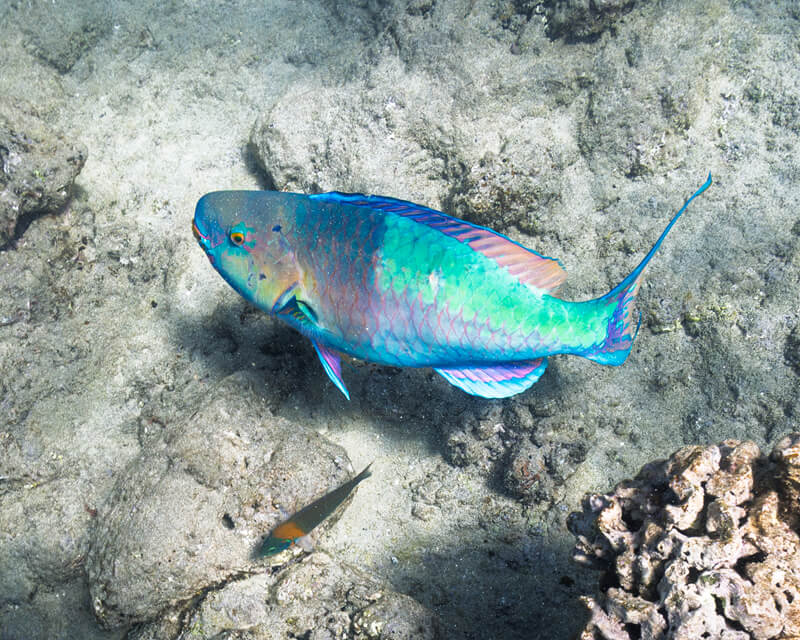
Parrotfish are reef fish named for their mouths. Instead of regular fish teeth, parrotfish have hard, beak-shaped jaws that look a lot like a parrot’s beak. This strong beak helps them scrape algae and bits of coral off rocks and reefs. Think of them as tiny underwater lawnmowers, always eating to keep the reef healthy.
Parrotfish come in many colors. Some are bright turquoise blue, while others are green and yellow. Many parrotfish change color as they mature, and some individuals change from female to male. Their appearance depends on species and life stage. It’s like a constant underwater fashion show.
These fish aren't shy. Snorkelers often see them grazing on the reef. Nearby, you may spot moray eels peeking from coral cracks. They tend to hang out in shallow, tropical waters, making Maui's reefs the perfect place to spot them!
Where To See Parrotfish in Maui?
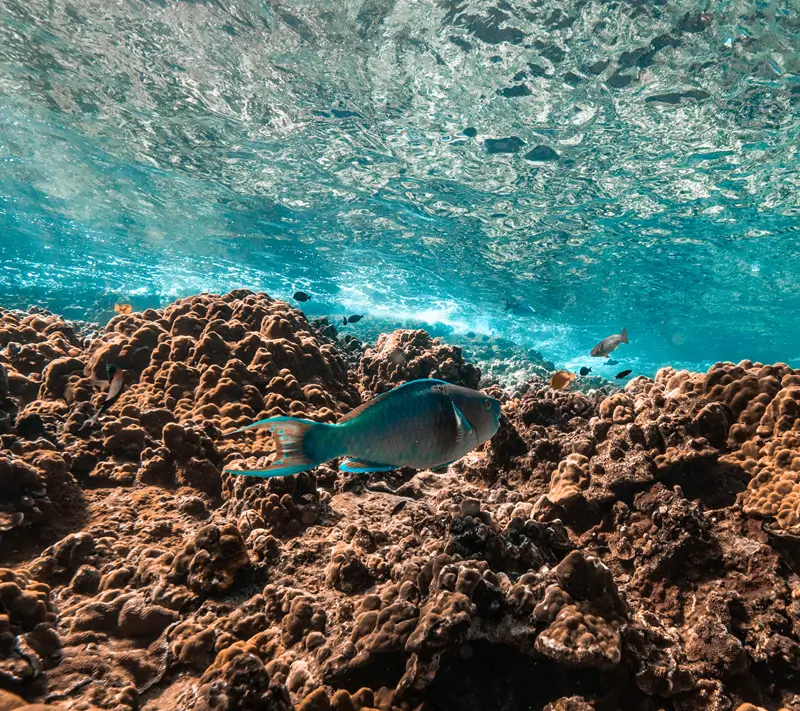
Parrotfish may be seen at both boat-access reefs and shore snorkeling sites around Maui. Molokini, Turtle Town, Coral Gardens, and suitable shore reefs offer different settings, but none guarantees a sighting. Choose your outing based on current conditions and your swimming ability, then watch for fish without following them into deeper water.
Best by Boat
Molokini Crater: Famous for clear water and reef structure inside the crescent. Parrotfish are often seen “munching” along the reef, especially on calm mornings.
Turtle Town (South Maui): A classic South Maui reef zone where you’ll often see ʻuhu grazing near coral heads and rock along the reef edge. You may also see Hawaiian green sea turtles, but sightings aren’t guaranteed.
Coral Gardens (West Maui): Coral Gardens offers coral formations and reef-fish habitat. Suitability depends on the day’s wind, swell, visibility, and currents; it isn’t automatically a good alternative when winds increase.
Best from Shore
Shore snorkeling requires ocean-swimming experience and suitable conditions. Check surf, currents, visibility, water-quality advisories, and posted warnings. Snorkel with a buddy, and choose a land-based activity if conditions aren't right. For a quick check before you go, use our Maui snorkel conditions guide.
Maluaka Beach (Turtle Town area): One of the most popular shore-entry options in South Maui for reef fish (including parrotfish). Scan the reef edges where rock meets sand, and you’ll often find ʻuhu grazing.
Napili Bay: A protected West Maui cove that can be great for calmer-morning snorkeling. Parrotfish often cruise and feed along the bay's rocky edges when visibility is good.
Honolua Bay: A stunning reef bay, but it’s very condition-dependent. It’s typically better in calmer seasons; if there’s significant swell or poor visibility, it’s a “skip it” day.
Black Rock (Kaʻanapali): A famous shore snorkel with deeper water nearby. ʻUhu can be seen along the reef structure on calm days, but only go when conditions are mellow, and choose this spot if you’re a confident swimmer.
Maui’s parrotfish don’t all look alike, and individuals can change
appearance as they grow. Compare these six species using body
shape, mouth, tail, and markings rather than color alone.
Some are more likely to be encountered on a shallow snorkeling
outing than others.
Species
Identification clues
Color and life-stage differences
Viewing note
Bullethead parrotfish
Chlorurus spilurus
Blunt, angular head, visible fused jaws, and a relatively
square tail
Earlier phases can be reddish-brown with pale spots and
a light band near the tail. Terminal-phase males are
often blue-green with yellow or orange areas.
A common shallow-reef species. Watch for grazing
without moving closer to the reef.
Palenose parrotfish
Scarus psittacus
Oval body, slightly protruding snout, jaws largely
covered by the lips, and slightly extended tail corners
Young fish and females may be mottled gray or olive.
Terminal-phase males can show blue, pink, and yellow
hues with a yellow-green patch near the tail base.
Common around reef habitat. A muted gray or olive fish
may be this species, not a different fish family.
Redlip parrotfish
Scarus rubroviolaceus
Elongated body, blunt angular head, exposed fused jaws,
and long trailing tips on the tail
Earlier phases may be reddish or yellowish-brown.
Terminal-phase males are often turquoise or green.
Some individuals show a distinctly two-toned body.
One of the larger parrotfish on Maui’s reefs.
Don’t rely on red lips alone to identify it.
Stareye parrotfish
Calotomus carolinus
Terminal-phase males have pink lines radiating from
the eyes. The jaws have a rougher, pebble-like texture
rather than a smooth exposed beak.
Females can be brown or mottled with pale scale edges.
Terminal-phase males are blue-green with the
distinctive eye markings.
Watch for feeding around algae-covered reef surfaces.
Eye markings are more useful than eye size alone.
Spectacled parrotfish
Chlorurus perspicillatus
Broad oval body, blunt head, and square tail.
Terminal-phase males have a conspicuous dark band
across the snout in front of the eyes.
Females may be purplish-brown with red fins and a
broad white band near the tail. Terminal-phase males
are blue-green with contrasting head markings.
Compare the head markings and tail shape carefully.
Not every large blue-green parrotfish is this species.
Regal parrotfish
Scarus dubius
Oval body, slightly protruding snout, jaws largely
covered by the lips, and slightly extended tail margins
Females can be rose-colored with faint pale belly
stripes. Males may be orange or fuchsia with blue
markings on the face and fins.
Uncommon around the main Hawaiian Islands and
associated with deeper reefs. Don’t expect it on
every shallow snorkeling outing.
Note: These are identification clues, not guarantees.
Color varies with species, age, life stage, and underwater lighting,
and color alone doesn’t establish a fish’s sex. Compare several
features, observe without following or feeding fish, and leave the
identification uncertain when the view isn’t clear.
Are ʻuhu protected on Maui?
Parrotfish are subject to fishing regulations, and Maui prohibits taking certain large male ʻuhu. Other restrictions depend on the fish and location. If you plan to fish, check current DLNR regulations and the rules for the specific area rather than relying on this snorkeling guide.
Why Are They Important?
Parrotfish help shape reef habitats through their feeding. By grazing on algae and reef surfaces, they can help keep algae from taking over space where corals grow.
Many shallow-water corals depend on microscopic algae living inside their tissues. Those algae use sunlight to produce food that supports the coral. Keeping excessive algae growth in check is one part of maintaining suitable conditions for coral.
Some parrotfish also produce sand. As they feed, they swallow bits of calcium-carbonate reef material, grind it into smaller particles, and pass it out as sediment. The amount varies with species, size, and feeding behavior. Parrotfish contribute to tropical sand, but they aren’t the source of every grain on Maui’s beaches.
What Do Parrotfish Look Like?
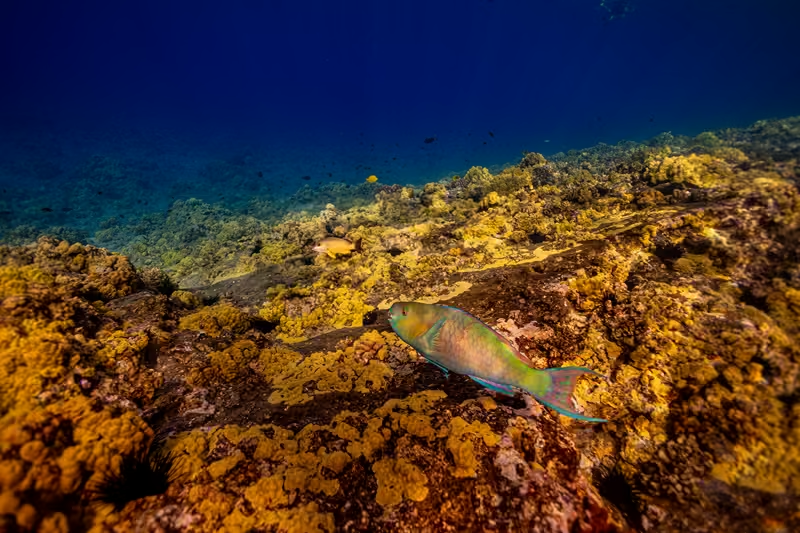
Parrotfish can be blue, green, pink, brown, reddish, or mottled. Their appearance changes with species and life stage, so two different-looking fish can belong to the same species. Compare their mouth, head shape, tail, and markings rather than relying on color alone.
Some parrotfish make a mucus cocoon when resting at night. Research has shown that these cocoons can reduce attacks by small parasitic crustaceans. Not every species uses one.
Colorful Changes: The Amazing Life Cycle of Parrotfish
These fish's lives are full of surprises, especially in their appearance and even their gender! Many parrotfish species go through fascinating changes throughout their lives. Color alone doesn’t reliably establish a parrotfish’s sex.
Color Transformations: Young parrotfish often look very different from adults, with duller colors and various patterns. As they mature, they can undergo dramatic color changes, sometimes multiple times!
Sex Changes: In some parrotfish species, individuals can even change their sex! They may start as females and later become males. This often happens due to social dynamics within the group. Sometimes, the largest and most dominant female becomes the dominant male.
These transformations are a testament to the incredible adaptability of these reef dwellers. It’s like watching a real-life underwater metamorphosis!
How to Snorkel Around Parrotfish Respectfully
When you spot parrotfish, float calmly and give them space to graze. Don't chase, touch, feed, or block them. Watch from the side, keep your fins away from coral, and avoid standing on the reef. If the water is rough, murky, or surging, skip snorkeling and choose a land-based activity instead.
How to Help Protect Parrotfish
Because these fish are crucial to coral reefs, we need to do our part in protecting them. Here’s how you can help when snorkeling or visiting Maui:
Don’t feed the fish. It may seem fun, but it changes their natural behavior.
Don’t touch the coral. Coral is alive and very fragile.
Use mineral sunscreen. Follow Maui County’s mineral-only sunscreen requirements rather than relying on a “reef-safe” marketing label.
Don’t take fish or coral from the reef. Leave everything as you found it.
Respect marine life. Watch from a distance and don’t chase or scare the fish.
The more we care for the ocean, the more amazing experiences we’ll have, like swimming with parrotfish!
FAQs
Parrotfish are called ʻuhu in Hawaiʻi. You may also see the name written as uhu without the ʻokina.
Yes, first-time snorkelers may see parrotfish during a suitable snorkeling session. On our tours, guests should feel comfortable floating face-down in deep water and follow crew instructions. Independent shore snorkeling calls for experienced ocean swimmers who can swim independently. In either setting, check conditions, use a buddy, and avoid following fish beyond your comfort level.
Parrotfish may be seen at Molokini, Turtle Town, Coral Gardens, and suitable shore reefs around Maui. No location guarantees a sighting. Choose your snorkeling area based on current conditions and your swimming ability rather than following fish into deeper water.
Yes. As parrotfish scrape algae and reef material, hard grinding plates in their throat break some of that material into fine sand. That sand eventually passes through the fish and can become part of tropical beach sand.
Parrotfish feed on algae and other material growing on reef surfaces, with feeding habits that vary by species. Some scrape or excavate the surface as they feed, while others browse seaweed. Watch their natural feeding without offering food.
They’re important reef “gardeners.” By eating algae, parrotfish help prevent algae from smothering coral and blocking sunlight. Healthier coral means better habitat for the many fish and marine creatures that depend on the reef.
Parrotfish vary from brightly colored blue or green fish to brown, reddish, or mottled individuals. Compare their mouth, body shape, tail, and markings. Colors can change with species and life stage, so color alone isn’t enough for identification.
Yes. Many parrotfish look different as juveniles than they do as adults, and some species can shift colors dramatically as they mature. In certain species, individuals can also change sex (often from female to male) depending on the group’s social dynamics.
Ready to Explore Maui’s Underwater World?
Experience Maui’s ocean environment aboard the Lani Kai II. We’ll provide snorkel gear, food, and friendly crew support, so you can focus on the adventure!
Tours depart from Maʻalaea Harbor. Routes, snorkel sites, and marine life sightings vary with ocean conditions.
Final Tips for Seeing Parrotfish in Maui
Parrotfish are worth watching for more than their colors. Notice how they move, graze, and use their mouths, and remember that a brown or mottled fish can be just as interesting as a bright blue one. Give ʻuhu room to feed, keep your fins clear of the reef, and use our Maui fish identification guide to recognize their neighbors. 🤿
Sources & Updates
Use these identification guides and scientific resources to
learn about parrotfish species, color changes, feeding,
sand production, and nighttime behavior. Before snorkeling,
check current ocean conditions, water quality advisories,
and safety guidance. Fishing rules and sunscreen requirements
are linked separately below.