Langosta espinosa hawaiana en Maui: identificación, comportamiento y consejos para practicar snorkel.
julio 31st, 2026
| Vida marina
Escrito por el equipo de Maui Snorkeling, quienes operan tours en el Cráter Molokini, Turtle Town y Coral Gardens desde el puerto de Maalaea (Māʻalaea) desde 1985. Los tours son guiados por capitanes con licencia de la USCG a bordo de una Embarcación de pasajeros inspeccionada por la Guardia Costera de EE. UU.. Pasamos más días en estas aguas que en tierra.
Última actualización: 31 de julio de 2026
Respuesta rápida
El Hawaiian spiny lobster, scientifically known as Panulirus marginatus, is a reef-dwelling crustacean found only in the Hawaiian Archipelago and Johnston Atoll. Called ula in Hawaiian, it has extremely long antennae, a spiny armored shell, pale bands across its abdomen, and no oversized front claws. It usually hides beneath ledges or inside caves during the day and comes out at night to feed.
Conclusiones principales:
Scientific Name:Panulirus marginatus
Nombre hawaiano: Ula, with ula poni and ula hiwa also used for particular varieties
Best ID Clues: Very long spiny antennae, banded abdomen, striped legs, armored body, and no oversized claws
Dónde buscar: Beneath shaded reef ledges, inside caves, and around rocky crevices
Daily Behavior: Usually hidden during daylight and active on the reef after dark
Interesting Defense: It can make a grating or buzzing sound by rubbing structures near the base of its antennae
Regla para practicar snorkel: Don’t reach into its shelter, touch its antennae, block its exit, or try to pull it into view
You may not notice the Hawaiian spiny lobster right away. During a daytime Maui snorkel, the first clue may be two extremely long antennae extending from a dark reef hole like a pair of underwater security sensors.
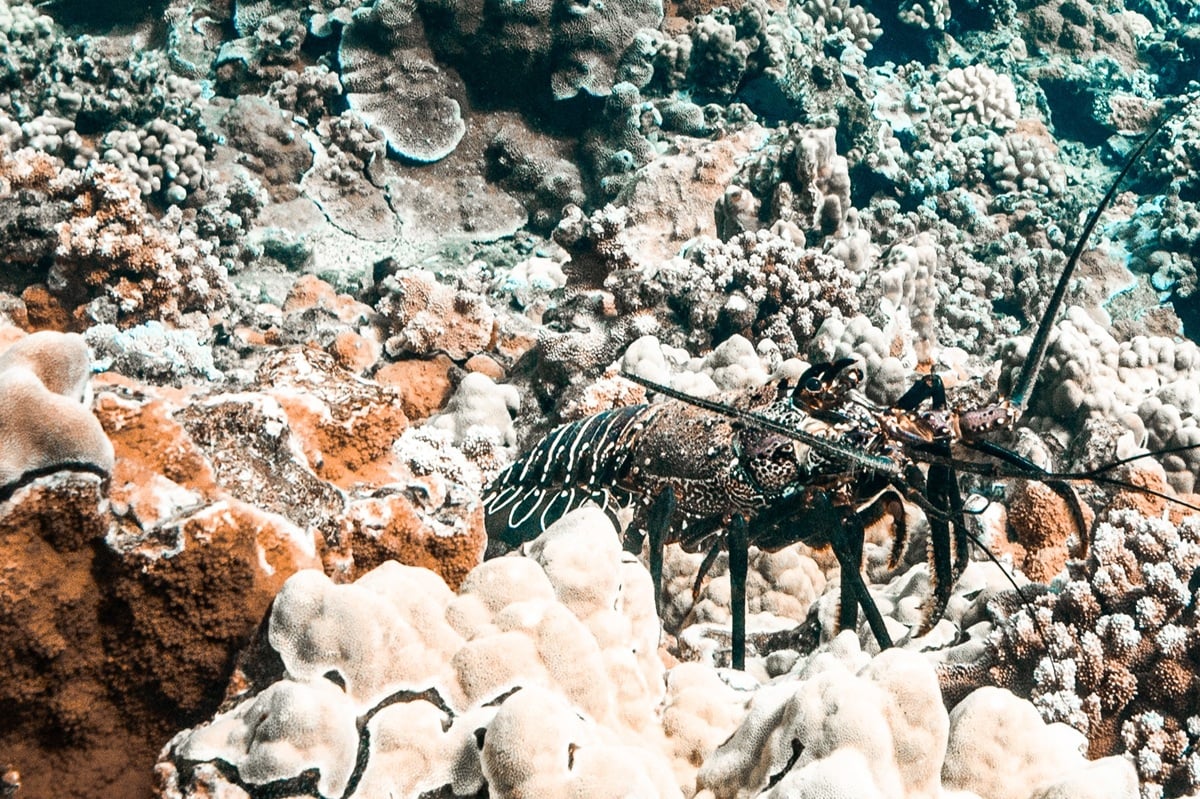
Look more carefully and you might see a heavily armored crustacean tucked beneath the ledge. It has a banded abdomen, long striped legs, small eyes, forward-pointing spines, and absolutely none of the oversized claws many visitors expect from a lobster.
The Hawaiian spiny lobster, scientifically known as Panulirus marginatus, is also called the banded spiny lobster. In Hawaiian, lobsters are known as ula, and this species may also be called ula poni or ula hiwa.
These nocturnal reef residents are much easier to overlook than yellow tangs, parrotfish, or sea turtles. That makes finding one beneath a Maui reef ledge a memorable surprise.
This guide explains how to identify a Hawaiian spiny lobster, where it hides, what it eats, why it makes noise, how it grows, how it differs from other lobsters, and what snorkelers should do during an encounter.
Hawaiian Spiny Lobster Quick Facts
Here’s a simple look at the Hawaiian spiny lobster, including its identification, habitat, diet, behavior, unusual sound, life cycle, and current Hawaiʻi harvest rules.
Tema
Detalles
Nombre común
Hawaiian spiny lobster or banded spiny lobster
Nombre científico
Panulirus marginatus
nombre hawaiano
Ula. Ula poni and ula hiwa are also used for particular varieties or color forms
Animal group
Crustacean in the spiny lobster family, Palinuridae
Natural range
Endemic to the Hawaiian Archipelago and Johnston Atoll
Approximate size
Large adults can reach approximately 16 inches in total length, although many are smaller
Las mejores pistas para identificar
Extremely long antennae, forward-pointing body spines, pale abdominal bands, striped legs, broad tail fan, and no oversized front claws
Body covering
A hard external skeleton called an exoskeleton protects and supports the lobster
Large claws
None. Spiny lobsters lack the oversized crushing pincers associated with Maine lobsters
Main defense
Sharp body spines, rigid antennae, secure reef shelters, warning sounds, and rapid backward tail movement
Dónde buscar
Beneath reef ledges, inside caves, around rocky crevices, and near sandy areas beside reef structure
Actividad diaria
Mostly nocturnal. It generally shelters during the day and comes out after dark to feed
Lo que comen
Mollusks, crustaceans, sea urchins and other echinoderms, small fish, fish remains, and other animal material
Sound
A grating, rasping, or buzzing noise produced through stridulation near the base of the antennae
Escape movement
Powerful abdominal muscles flex the tail and launch the lobster rapidly backward
How they grow
They periodically shed the old exoskeleton through molting and remain vulnerable until the new shell hardens
Eggs
Females carry fertilized eggs on appendages beneath the abdomen and fan them with water as they develop
Larval stage
Thin phyllosoma larvae may drift in the plankton for roughly nine months to a year before settling into bottom habitat
Especies similares
Red spiny lobster and several slipper lobsters also occur in Hawaiian waters
¿Son peligrosos?
They aren’t aggressive toward respectful observers, but their spines, mouthparts, antennae, and sudden escape movements make handling unsafe
Closed harvest season
Current Hawaiʻi rules close spiny lobster harvest from May through August
Minimum harvest size
Current statewide minimum is 3 1/4 inches measured by carapace length
Female protection
Current Hawaiʻi rules prohibit taking or killing female spiny lobsters
Other harvest rules
No spearing, and harvested animals must remain whole rather than mutilated
Consejo para practicar snorkel
Watch from outside the shelter, don’t touch the antennae, never reach into a reef hole, and leave the lobster a clear exit
Nota: Wildlife sightings aren’t guaranteed, and fishing regulations can change. Check the current Hawaiʻi Division of Aquatic Resources rules and any location-specific restrictions before collecting marine life.
What Is A Hawaiian Spiny Lobster?
The Hawaiian spiny lobster is a large marine crustacean in the family Palinuridae. Its scientific name is Panulirus marginatus.
Unlike many animals visitors associate with Hawaiʻi, this lobster has a remarkably limited natural range. It’s endemic to the Hawaiian Archipelago and Johnston Atoll, which means it isn’t naturally found across tropical reefs worldwide.
Its body is protected by a hard external skeleton called an exoskeleton. Instead of using large crushing claws for defense, it relies on a heavily armored body, sharp forward-pointing spines, very long antennae, a secure reef shelter, and a powerful tail.
Hawaiian spiny lobsters are both predators and scavengers within the reef community. They generally remain hidden during daylight and emerge after dark to search for food.
What Does Ula Mean In Hawaiian?
Ula is a Hawaiian word for spiny lobster. Hawaiian dictionary sources apply it to both the Hawaiian spiny lobster and the red spiny lobster found in Hawaiian waters.
Names can be further qualified by words including poni and hiwa. You may therefore see the Hawaiian spiny lobster called ula poni, meaning purple lobster, or ula hiwa, referring to its dark coloration.
The broader word ula shouldn’t automatically be treated as the name of one exact lobster species. Like many traditional animal names, it may cover closely related forms that are separated more narrowly by modern scientific classification.
How To Identify A Hawaiian Spiny Lobster
The Hawaiian spiny lobster has several useful identification clues. You’ll often see the antennae before you can see the entire animal.
Very Long Antennae: One pair is long, thick, rigid, and covered in small spines.
No Oversized Front Claws: It doesn’t have the giant pincers associated with Maine or American lobsters.
Armored Carapace: The hard upper shell is covered with bumps, spots, and forward-pointing spines.
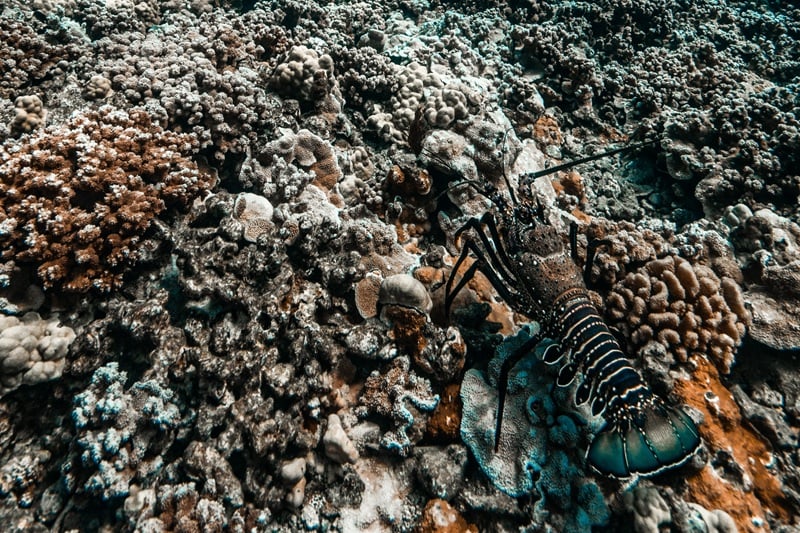
Banded Abdomen: Pale lines separate the darker abdominal segments and create a striped appearance.
Striped Walking Legs: Dark legs have noticeable pale lengthwise markings.
Broad Tail Fan: The tail opens into a powerful fan used for rapid backward escapes.
Dark Reef Coloration: The body may appear brown, purple, reddish, or nearly black depending on the animal, light, depth, and camera settings.
Underwater color can be deceptive. Red and purple tones disappear quickly with depth, causing a colorful lobster to look much darker than it does in a flash photograph or shallow water.
Why Doesn’t A Hawaiian Spiny Lobster Have Big Claws?
Visitors familiar with Maine lobster often expect every lobster to have two enormous pincers. Spiny lobsters follow a different design.
The Hawaiian spiny lobster doesn’t have enlarged front claws for crushing or defense. Instead, it relies on:
A thick, armored exoskeleton
Sharp spines across its upper body
Long, rigid, spiny antennae
Deep reef caves and crevices
A powerful tail for rapid backward movement
Sound that may warn an approaching animal to keep its distance
It still has strong mouthparts capable of processing hard-bodied prey. A lack of giant claws doesn’t mean it’s poorly equipped for reef life.
Where Do Hawaiian Spiny Lobsters Live Around Maui?
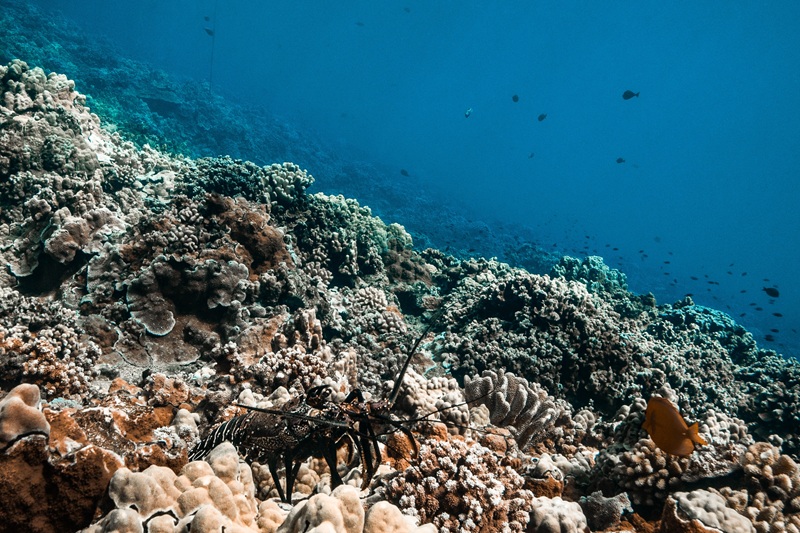
Hawaiian spiny lobsters live around rocky and coral reef habitats, from shallow coastal areas to much deeper water.
During daylight, they usually choose protected spaces such as:
Reef caves
Dark crevices
Spaces beneath lava ledges
Holes between large rocks
Protected areas near sandy reef edges
A lobster may sit far enough inside its shelter that only its antennae and the front of its head are visible. Others rest closer to the entrance, especially when the opening provides shade and several possible escape routes.
Healthy reef structure creates shelter for lobsters, fish, octopuses, eels, crabs, shrimp, and many other animals. Read our Maui Coral Reefs Guide to learn how reef structure supports this broader marine community.
Can You See A Hawaiian Spiny Lobster While Snorkeling?
Yes, a snorkeler may occasionally see a Hawaiian spiny lobster in shallow reef habitat. Daytime sightings can be challenging because the animal is usually hiding.
Your best chance isn’t to swim quickly over open sand. Move calmly and scan shaded reef edges from a respectful distance. Watch for:
Long antennae extending from a crevice
Pale abdominal bands inside a dark hole
Striped legs near the entrance to a cave
A lobster slowly shifting deeper into its shelter
Never put your hand, camera, selfie stick, or other object inside a reef hole. You may disturb the lobster, damage living coral, or encounter another animal you didn’t see.
Hawaiian spiny lobsters generally remain protected inside caves and crevices during daylight. After sunset, they emerge to search for food across the reef and nearby sandy areas.
This nighttime schedule offers several advantages. Darkness provides cover from visually hunting predators, and many of the slow-moving animals a lobster eats are also active or exposed after dark.
Nocturnal behavior also explains why divers may see an entire lobster moving across the reef at night while daytime snorkelers notice only antennae beneath a ledge.
That doesn’t mean visitors should attempt an unfamiliar night snorkel to find one. Darkness adds navigation, visibility, separation, entry, and exit risks. Wildlife is never worth entering conditions beyond your training and experience.
What Do Hawaiian Spiny Lobsters Eat?
Hawaiian spiny lobsters are carnivorous predators and scavengers. Their food can include:
Mollusks
Marine snails
Crustaceans
Sea urchins and other echinoderms
Small fish or fish remains
Other animal material found along the reef
They may move from reef structure onto nearby sandy bottom areas while feeding. Their strong mouthparts help break, scrape, and process food even without oversized claws.
Sea urchins are among the hard-bodied reef animals lobsters may consume. Learn how to identify several local species in our Maui Sea Urchins Guide.
Why Do Hawaiian Spiny Lobsters Make Noise?
One of the most surprising Hawaiian spiny lobster facts is that these animals can make a noticeable grating, buzzing, or rasping sound.
The process is called stridulation. The lobster rubs hard structures near the base of its antennae against specialized ridges on its head.
The resulting sound may warn other lobsters, predators, divers, or anything else approaching the shelter that the space is already occupied.
If a lobster begins making defensive movements or sounds, don’t move closer to investigate. Back away and allow it to settle.
How Does A Spiny Lobster Escape?
A Hawaiian spiny lobster may walk forward across the reef using its legs, but its emergency movement is much faster.
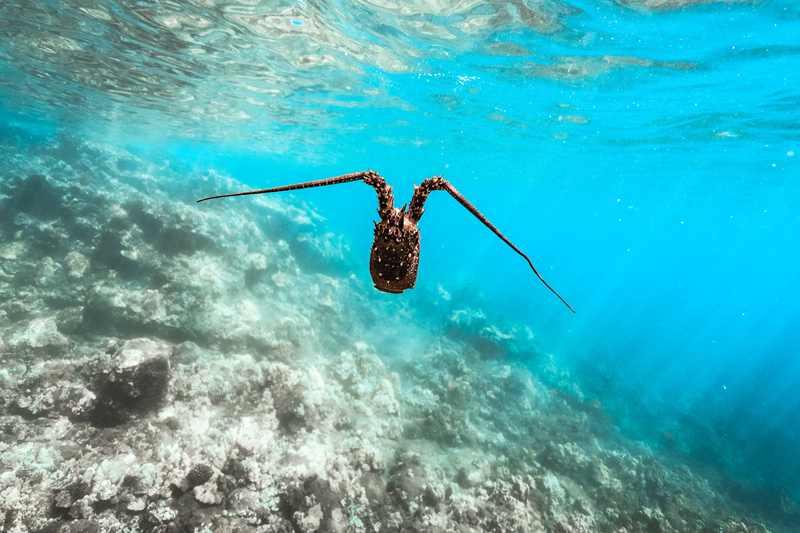
Powerful abdominal muscles allow the lobster to flex its tail suddenly and launch backward through the water. Several rapid tail movements can move it away from a threat before the approaching animal has time to react.
This is another reason not to block the opening of a cave. The lobster needs a clear route, and a startled animal may move suddenly toward open water.
How Does A Hawaiian Spiny Lobster Grow?
A hard exoskeleton provides excellent armor, but it can’t stretch as the animal grows. The lobster must periodically shed it through a process called molting.
Before a molt, a new soft shell forms beneath the old one. The old exoskeleton eventually splits, allowing the lobster to pull itself free.
The lobster expands the new shell with water before it hardens. During this vulnerable period, it usually remains deep inside reef shelter where predators and other lobsters are less likely to find it.
An empty lobster-shaped shell on the reef may therefore be a discarded exoskeleton rather than a dead animal. Don’t remove it. Molted shells return nutrients and minerals to the reef system.
How Do Hawaiian Spiny Lobsters Reproduce?
During reproductive periods, a male places a packet of sperm near the female’s reproductive opening. The female fertilizes her eggs as they leave her body and attaches them beneath her abdomen.
The egg mass may look like hundreds of tiny reddish, orange, brown, or dark berries. This is why an egg-carrying lobster is sometimes described as a berried female.
The female fans and cleans the developing eggs with specialized appendages. After hatching, the young enter the ocean as extremely thin, transparent larvae called phyllosoma.
These larvae can spend roughly nine months to a year drifting through the plankton before transforming and settling into bottom habitat. That long open-ocean stage helps connect lobster populations across the Hawaiian Archipelago, but it also exposes recruitment to changing currents and ocean conditions.
Hawaiian Spiny Lobster Vs Maine Lobster
The Hawaiian spiny lobster and the Maine lobster are both crustaceans, but they’re easy to distinguish.
Hawaiian Spiny Lobster
Has extremely long, spiny antennae
Doesn’t have oversized front pincers
Uses body spines, shelter, sound, and tail movement for defense
Lives in warm Pacific reef habitat
Has banding and colorful markings across its body and legs
Maine Lobster
Has two large front claws
Uses those claws for feeding and defense
Lives in colder North Atlantic waters
Has shorter antennae relative to the dramatic whip-like pair on a spiny lobster
Has a different body shape and coloration
If you see a lobster beneath a Maui reef ledge with giant antennae but no giant claws, you’re looking at a spiny lobster rather than a Maine-style lobster.
Similar Lobsters Found In Hawaiian Waters
Not every lobster seen around Hawaiʻi is Panulirus marginatus. Several related species occur in Hawaiian waters.
Red Spiny Lobster
The red spiny lobster, Panulirus penicillatus, is a more widely distributed Indo-Pacific species. It also has very long antennae, a spiny body, and no oversized front claws.
Color and pattern differences can be difficult to evaluate underwater, especially when the lobster is partly hidden. Photograph the abdomen, legs, head, and tail fan when possible, but don’t move closer or pull the animal into view for identification.
Slipper Lobster
Slipper lobsters have a much flatter body and broad, plate-like antennae rather than the long whip-like antennae of a spiny lobster. Their shape may remind you of an armored underwater shovel.
Hawaiian fishing regulations list slipper lobsters separately from spiny lobsters because the identification features, size measurements, and some harvest rules differ.
Are Hawaiian Spiny Lobsters Dangerous?
A Hawaiian spiny lobster isn’t an aggressive threat to a snorkeler who observes it from a respectful distance.
However, the lobster’s body and antennae are covered with sharp spines. It also has powerful mouthparts and can make an abrupt backward escape when startled.
Don’t:
Touch or grab the lobster
Pull its antennae
Reach inside its shelter
Block the opening to its cave
Corner it for a photograph
Attempt to pick up a molting or soft-shelled animal
Keeping your hands away from reef holes protects you from lobsters, eels, urchins, sharp coral, hidden fishing line, and other hazards that may not be visible from the surface.
¿Qué debes hacer si ves uno?
Stop And Float: Slow your kicking so you don’t stir sand or strike the reef.
Mantén la distancia: Stay outside the lobster’s shelter rather than approaching the opening.
Look For The Antennae: Notice their length, thickness, and defensive position.
Check The Body Pattern: Look for pale bands across the abdomen and light striping on the legs.
Leave An Exit: Don’t surround the cave or block the lobster’s route into deeper shelter.
Toma algunas fotos tranquilas: Use zoom rather than pushing your camera closer.
Move On: Let the lobster return to resting without repeated approaches from the group.
A good wildlife encounter leaves the animal behaving the same way it was before you arrived.
How To Photograph A Hawaiian Spiny Lobster Responsibly
A lobster beneath a dark reef ledge can be difficult to photograph because the camera sees bright open water and a shaded subject at the same time.
Move Slowly: Rapid fin movement may send the lobster deeper into the crevice.
Photograph From Outside: Don’t insert your camera into the shelter.
Use Zoom: Digital or optical zoom is safer than placing the lens near the lobster’s face.
Capture The Antennae: A wider composition showing the full antennae helps explain the species.
Photograph The Abdomen And Legs: Banding and stripes can support later identification.
Avoid Repeated Bright Light: Take a few photographs rather than repeatedly lighting a nocturnal animal inside a dark cave.
Controla tus aletas: Don’t kick coral, sand, or the roof of the lobster’s shelter.
Include The Habitat: A wider image beneath the ledge tells a stronger natural-history story than a tightly cropped face.
¡Reserva tu plaza en una excursión de snorkel en Maui! Disfruta de un día inolvidable en el mar con equipo de snorkel, comida, asistencia de la tripulación y una sencilla reserva online.
Mejor visibilidad: Excursión matutina al cráter de Molokini y a Turtle Town.
Más relajado: Visita guiada por la tarde a Coral Gardens
This article focuses on responsible wildlife observation, not harvesting. However, visitors should understand that Hawaiʻi regulates spiny lobster take and that the rules are more restrictive than many people expect.
The current statewide Hawaiʻi Division of Aquatic Resources page lists these rules for ula, or spiny lobster:
Closed Season: May through August
Minimum Size: 3 1/4 inches measured by carapace length
Female Protection: No taking or killing female spiny lobsters
No Spearing: Spiny lobsters may not be taken with a spear
Whole Condition: A harvested lobster must remain whole and may not be mutilated
These are statewide baseline rules. Marine Life Conservation Districts, reserves, fisheries management areas, military areas, park waters, or other managed locations may have additional restrictions or prohibit take entirely.
Fishing regulations can change. Anyone considering harvest should check the current Hawaiʻi Division of Aquatic Resources rules and the regulations for the exact location before entering the water.
Why Hawaiian Spiny Lobsters Matter To The Reef
Hawaiian spiny lobsters are predators and scavengers within the reef food web. They consume mollusks, crustaceans, echinoderms, fish remains, and other animal material.
This feeding helps move energy through the reef ecosystem and process material that might otherwise remain on the bottom. The lobster also becomes food for larger reef predators during different stages of its life.
Its caves and ledges are part of the same reef structure used by eels, octopuses, crabs, shrimp, resting fish, and many other animals. Protecting reef habitat protects the entire community rather than one photogenic species at a time.
Explore more animals that live on land and beneath the surface in our Maui Wildlife Guide.
Planifica un día seguro de snorkel en Maui.
Finding a hidden lobster requires calm observation, but safe conditions come first. Don’t stare into reef holes so intently that you lose track of your buddy, shoreline, boat, waves, or current.
Consulte los avisos sobre viento, oleaje, visibilidad, lluvia y calidad del agua.
Snorkel with a capable buddy.
Choose conditions that match your swimming ability.
Keep your hands and feet away from coral and reef holes.
Use flotation when it helps you remain relaxed and controlled.
Look up regularly to confirm your position.
Return before fatigue, anxiety, or cold becomes a problem.
Never chase or handle marine life.
Anyone entering the water should be comfortable in deep water, able to swim independently, remain calm while floating face-down, and follow crew instructions. Flotation can reduce effort, but it doesn’t replace swimming ability or water comfort.
Yes. Hawaiian spiny lobsters live around rocky and coral reef habitats throughout the Hawaiian Archipelago. They may occur in shallow Maui reef areas, but daytime snorkelers often miss them because they hide beneath ledges and inside caves.
The Hawaiian word for spiny lobster is ula. Names including ula poni and ula hiwa are also used for particular varieties or color forms.
Look for extremely long spiny antennae, a heavily armored body, pale bands across the abdomen, striped legs, a broad tail fan, and no oversized front claws. The scientific name is Panulirus marginatus.
Spiny lobsters use a different defense strategy from Maine lobsters. They rely on body spines, rigid antennae, reef shelters, warning sounds, and powerful backward tail movements rather than oversized crushing pincers.
It’s possible, especially around reef ledges and rocky crevices, but sightings aren’t guaranteed. During the day, you may see only the lobster’s antennae extending from a dark shelter.
They feed on mollusks, crustaceans, sea urchins and other echinoderms, small fish, fish remains, and other animal material found around the reef and nearby sandy bottom.
They can produce a grating or buzzing noise through a process called stridulation. The lobster rubs hard structures near the base of its antennae against specialized ridges on its head, creating a warning sound.
They aren’t aggressive toward respectful observers, but their antennae and bodies have sharp spines. They also have strong mouthparts and can move backward suddenly, so you should never touch, grab, corner, or handle one.
Current statewide rules close spiny lobster harvest from May through August, require a minimum carapace length of 3 1/4 inches, prohibit spearing, require whole animals, and prohibit taking or killing females. Location-specific rules may be stricter.
Final Thoughts On The Hawaiian Spiny Lobster
The Hawaiian spiny lobster is one of Maui’s most impressive hidden reef residents. It has enormous antennae, an armored shell, a striped body, no oversized front claws, a powerful backward escape, and the ability to make its own warning sound.
It’s also easy to miss. During the day, the lobster may remain deep beneath a ledge while hundreds of snorkelers pass overhead without noticing the antennae extending from the shadows.
If you find one, slow down. Stay outside the shelter, keep your hands away, take a few respectful photographs, and leave the lobster a clear path.
The best marine-life discoveries aren’t created by pulling an animal into view. They happen when you become patient enough to notice what the reef was already doing.
Fuentes y actualizaciones
Use these trusted resources to confirm Hawaiian spiny lobster identification, behavior, distribution, cultural names, life history, current fishing regulations, and responsible snorkeling guidance.