Verfasst von
Schnorcheln auf Maui, Seit 1985 bietet das Unternehmen Touren zum Molokini-Krater, nach Turtle Town und zu den Korallengärten ab dem Hafen von Māʻalaea an. Die Touren werden von Kapitänen mit USCG-Lizenz an Bord eines Schiffes geleitet.
von der US-Küstenwache inspiziertes Passagierschiff.
Letzte Aktualisierung: 19. Oktober 2026
Kurzantwort
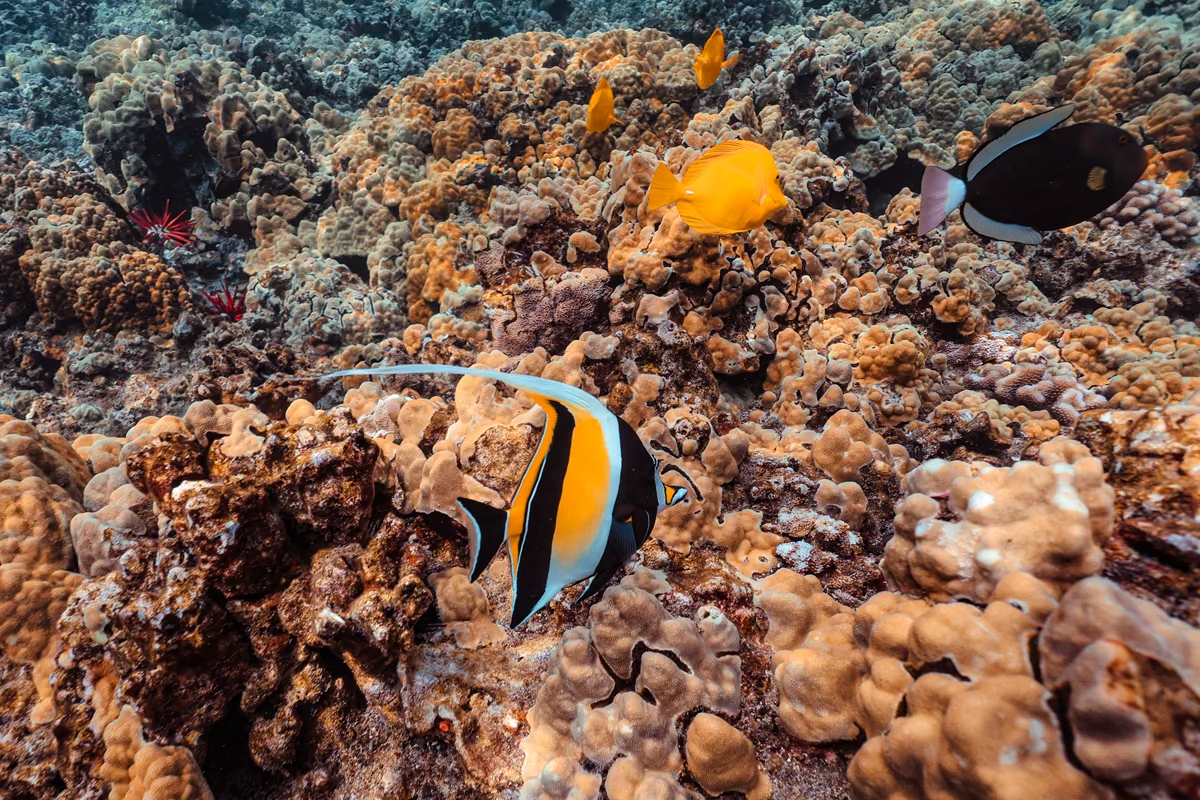
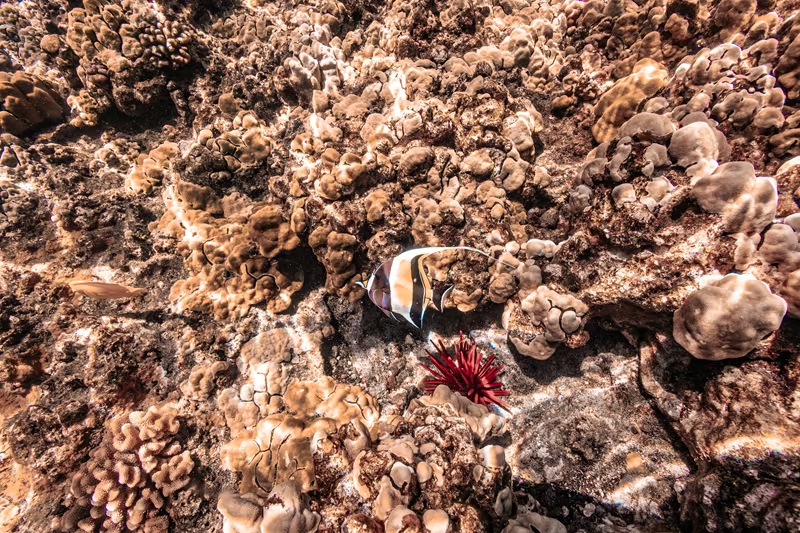
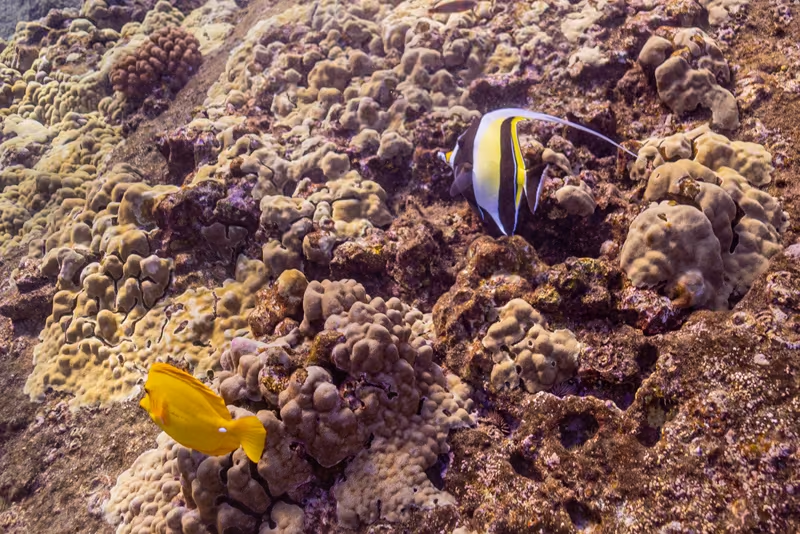
Maurische Götzenfische in Maui, angerufen Kihikihi in Hawaiʻi, have a tall, flattened body with black, white, and yellow markings and a long white dorsal streamer. For a more confident identification, look for the black tail und orange-to-yellow saddle across the projecting snout. These details help distinguish them from similar bannerfish. You may see Moorish idols picking food from rocky or coral reef surfaces, alone, in pairs, or in groups.
Wichtigste Erkenntnisse:
-
Hawaiianischer Name: Kihikihi; the scientific name is Zanclus cornutus.
-
Best identification clues: Combine the striped body and dorsal streamer with the black tail and orange-to-yellow snout marking.
-
Common lookalike: Schooling bannerfish also have a dorsal streamer, but their tail is yellow and their jaw is pale.
-
Wo man suchen muss: Watch rocky and coral reef surfaces along your normal snorkeling route. Don’t swim toward deeper ledges or drop-offs to search for fish.
-
What they eat: Sponges, algae, and other small organisms picked from reef surfaces and crevices.
-
Tipp zum Ansehen: Observe without chasing, feeding, or touching fish, and keep your body and fins clear of coral. Sightings aren’t guaranteed.
Der Maurische Götzenfische in Maui ist einer der am leichtesten zu erkennenden Rifffische. In Hawaii heißt er Kihikihi, und Schnorchler erkennen sie oft an ihren schwarzen, weißen und gelben Bändern, ihrem hohen, flachen Körper und ihrem langen, nach hinten gerichteten Rückenfaden.
Dieser Leitfaden erklärt, wie man einen Wimpelfisch erkennt, wo man ihn beim Schnorcheln in Maui am ehesten beobachten kann, was er frisst und wie man Rifffische beobachten kann, ohne das Riff zu stören.
Kurzinfos zum maurischen Götzenbild
Get to know kihikihi, from its distinctive black tail and
trailing dorsal fin to its reef-feeding habits and wide
natural range.
| Thema |
Einzelheiten |
| Gebräuchlicher Name |
Moorish idol |
| Hawaiianischer Name |
Kihikihi |
| Wissenschaftlicher Name |
Zanclus cornutus
|
| Fischfamilie |
Zanclidae. The Moorish idol is the family’s only
living species.
|
| Reported maximum size |
About 9 inches (23 cm) in total length, as reported
by FishBase
|
| Best identification clues |
Tall, flattened body with black, white, and yellow
markings; a long white dorsal streamer; a black tail;
and an orange-to-yellow saddle across the projecting snout
|
| Heimatgebiet |
Indo-Pacific and tropical eastern Pacific.
Native to Hawaiʻi, but not found only in Hawaiʻi.
|
| Riff-Lebensraum |
Rocky and coral reefs, reef flats, and lagoons.
Its habitat is not limited to pristine coral or
clear water.
|
| Social behavior |
May be seen alone, in pairs, or in groups;
larger schools also occur
|
| What it eats |
Sponges, algae, and other small organisms picked
from reef surfaces and crevices
|
| Häufiges Ebenbild |
Schooling bannerfish. Compare the Moorish idol’s
black tail and orange-to-yellow snout marking
with the bannerfish’s yellow tail and pale jaw.
|
Hinweis: The size listed is an approximate
published maximum, not the expected size of every Maui
sighting. Compare several identification features rather
than relying on the dorsal streamer alone.
References:
Waikīkī Aquarium: Maurisches Idol
und
FishBase: Zanclus cornutus.
Lerne den maurischen Götzenfisch kennen
Although it resembles a butterflyfish, the Moorish idol belongs to its own family, Zanclidae, and is closely related to surgeonfish. Unlike tangs, it lacks the sharp, scalpel-like spine beside the tail.
Moorish idols are native to Hawaiʻi but aren’t Hawaiian endemics. Their natural range extends across the Indo-Pacific and into the tropical eastern Pacific.
In Hawaiʻi wird das maurische Idol genannt Kihikihi. Das Erlernen der gebräuchlichen hawaiianischen Fischnamen kann das Schnorcheln bedeutungsvoller machen, da es Ihnen hilft, die im Wasser sichtbaren Riffbewohner zu erkennen.
Wie man ein maurisches Götzenbild erkennt
Beim Schnorcheln in Maui sollten Sie nach diesen maurischen Götzenbildern Ausschau halten:
- Markante schwarze, weiße und gelbe Streifen: Das kontrastreiche Muster ist der einfachste Hinweis.
- Langer Rückenstreifen: Eine dünne, nachlaufende Flosse erstreckt sich vom Rücken des Fisches.
- Groß, flacher Körperbau: Maurische Götzenbilder wirken von vorn betrachtet schlank und von der Seite betrachtet hochgewachsen.
- Röhrenförmige Schnauze: Das leicht verlängerte Maul hilft ihnen, Nahrung von Riffoberflächen und aus Spalten aufzupicken.
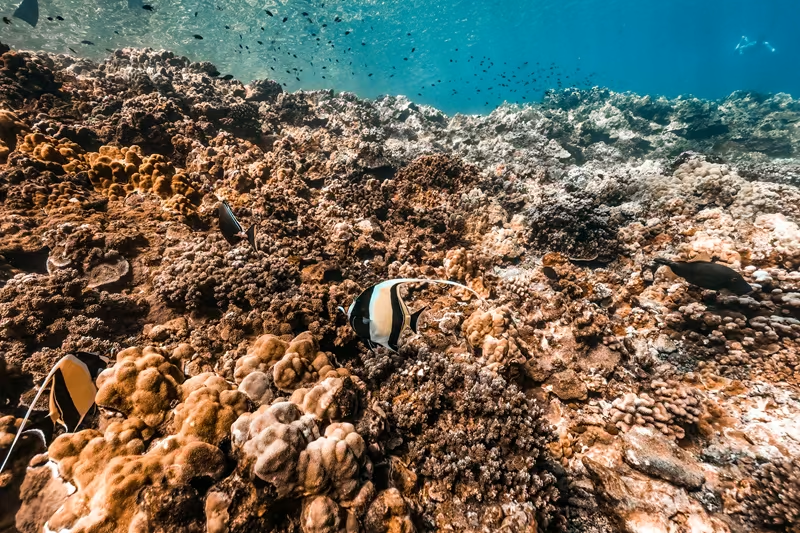
- Riffumfassende Bewegung: Sie schwimmen oft in der Nähe von Korallen, Felsen und Riffkanten, anstatt über offenem Sand zu bleiben.
- Black tail: Look beyond the striped body to the dark tail fin, an important clue when comparing similar bannerfish.
- Snout marking: Look for an orange-to-yellow saddle across the projecting snout.
Moorish Idol vs Bannerfish
A long dorsal streamer and striped body can make these fish easy
to confuse. This comparison focuses on the schooling bannerfish,
also called pennantfish or false Moorish idol. Start with the
tail color and snout markings rather than the streamer alone.
| Besonderheit |
Moorish idol
Zanclus cornutus
|
Schooling bannerfish
Heniochus diphreutes
|
| Tail color |
Black tail, often outlined by a narrow pale edge
|
Yellow tail, with yellow also covering the rear portion
of the dorsal fin
|
| Snout and face |
Projecting snout with an orange-to-yellow saddle across
the upper jaw
|
Shorter snout and pale jaw, with dark snout markings
rather than an orange-to-yellow saddle
|
| Body pattern |
Tall, flattened body with broad black bands and
white-to-yellow areas
|
Silvery-white body with two broad, diagonal dark bands
and yellow rear fins
|
| Rückenstreifen |
Long, thin, trailing extension from the dorsal fin
|
Also has a long dorsal extension, so this feature
alone does not distinguish the fish
|
| Feeding behavior |
Often picks food from reef surfaces and crevices
|
Often feeds on plankton above the reef and may
gather in schools
|
| Fischfamilie |
Zanclidae, the Moorish idol family
|
Chaetodontidae, die Falterfischfamilie
|
Hinweis: Start with the tail and snout markings,
then compare body shape and behavior. Swimming position is a
supporting clue, not a definitive identification rule.
References:
Waikīkī Aquarium: Maurisches Idol
und
Fishes of Australia: Schooling Bannerfish.
Was essen maurische Götzenbilder?
Moorish idols use their projecting snout to pick food from reef surfaces and crevices. Their diet includes sponges, algae, and other small organisms growing on the reef. Watch for brief pauses as a fish investigates a surface, then moves to another feeding spot.
They may forage alone, in pairs, or in groups. Observing from a distance lets you watch this feeding behavior without interrupting it.
Wo man beim Schnorcheln auf Maui maurische Götzenbilder sehen kann
Moorish idols occur around rocky and coral reef habitats in Hawaiʻi. On Maui, snorkelers may encounter them at Molokini, Coral Gardens, Honolua Bay, and other reef sites. Sightings vary, and seeing one doesn’t establish that the surrounding reef is healthy.
Watch reef surfaces from your normal snorkeling route rather than swimming toward deeper ledges or drop-offs to search for fish. Choose the site based on current conditions, not the possibility of a particular sighting.
Wenn Sie eine Liste aller Schnorchelgebiete auf Maui wünschen, beginnen Sie mit unserer Die besten Schnorchelplätze auf Maui Anleitung.
Eine kurze Anmerkung zu Aquarien.
Maurische Götzen werden gelegentlich im Aquarienhandel angeboten, gelten aber als äußerst schwierig in der Haltung. Selbst offizielle Quellen weisen darauf hin, dass sie sich in Heimaquarien in der Regel nicht wohlfühlen, vor allem aufgrund ihrer speziellen Ernährung und Pflege.
Abschließende Gedanken
A long dorsal streamer may catch your attention first, but the black tail and orange-to-yellow snout marking help confirm a Moorish idol. Once you recognize kihikihi, watch how it pauses to feed and moves between reef formations. Mahalo for reading!
👉 Give the fish room, keep clear of coral, and use our Maui-Führer für tropische Fische to identify other reef residents.
Quellen & Updates
Use these resources to learn about Moorish idol identification, feeding behavior, native range, and differences from schooling bannerfish. Before snorkeling, check current ocean conditions, water quality advisories, and safety guidance.