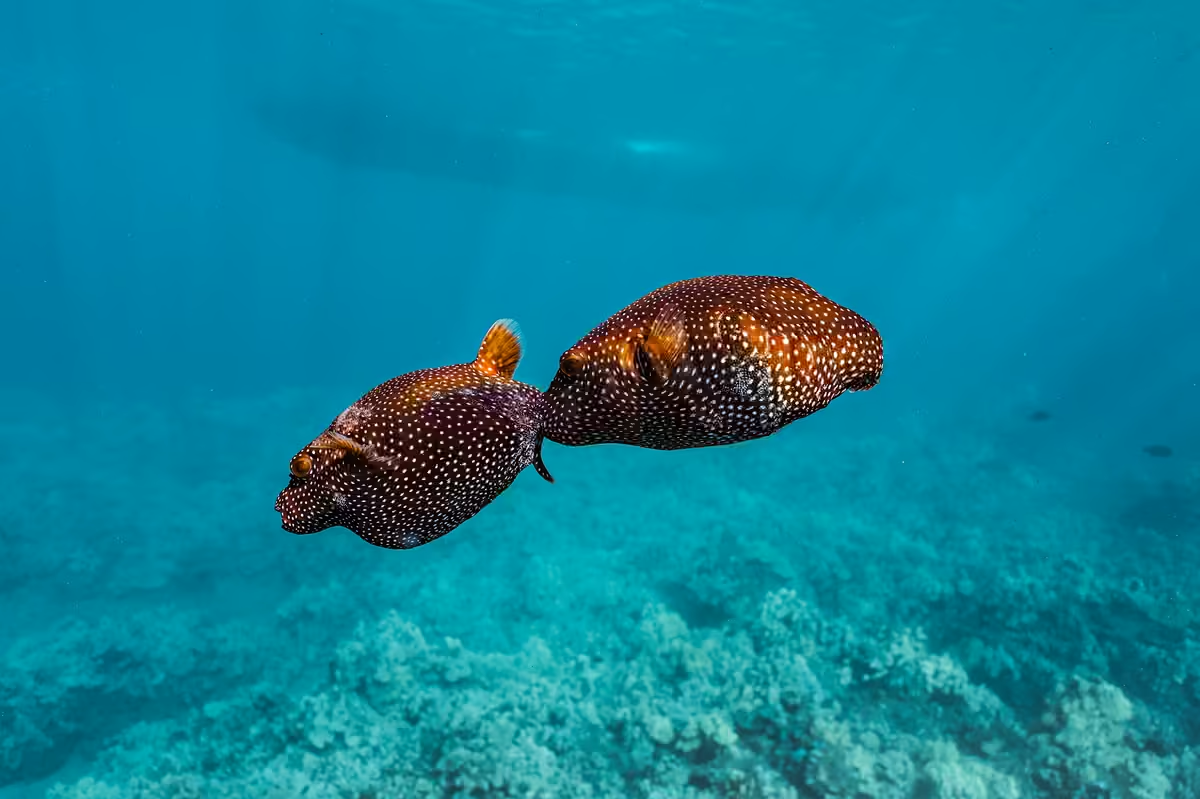
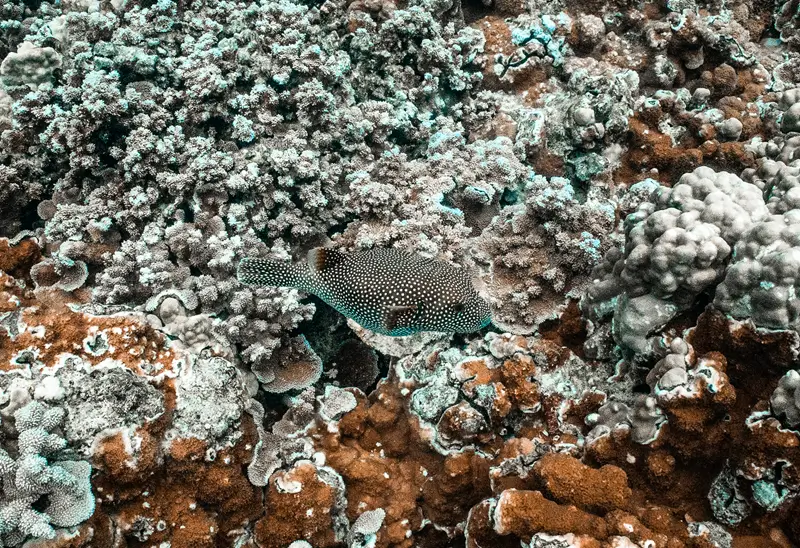
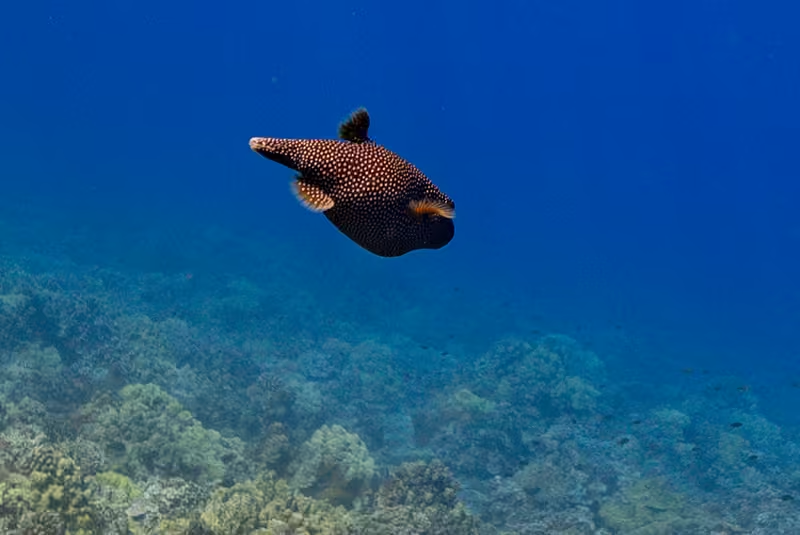
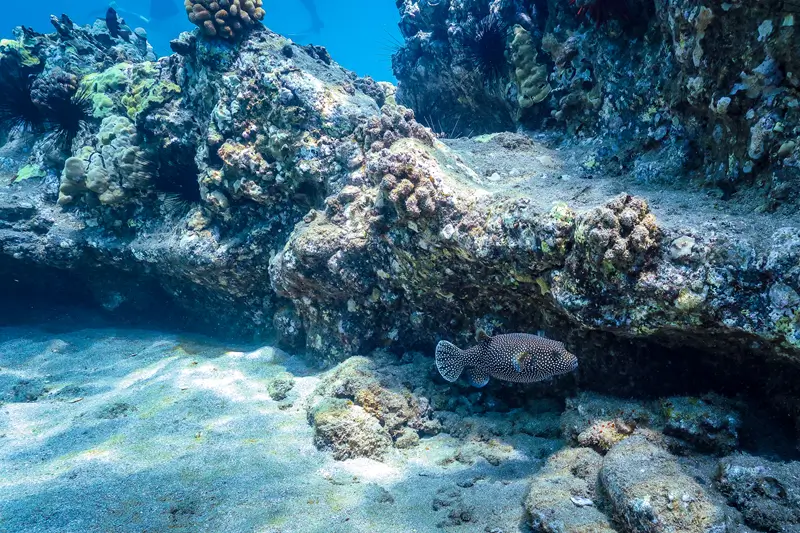
Pufferfish in Maui include large true puffers such as the guineafowl puffer and white-spotted puffer, plus the much smaller Hawaiian whitespotted toby. True puffers belong to the family Tetraodontidae and usually have smooth-looking bodies or very short prickles rather than the long spines of a porcupinefish. They can inflate when threatened, but snorkelers should never chase, touch, corner, feed, or deliberately frighten one into puffing up.
主な要点:
Largest Featured Species: Guineafowl and white-spotted puffers can each reach approximately 20 inches
Small Endemic Species: The Hawaiian whitespotted toby grows to only about 3.5 inches and is found naturally only around Hawaiʻi
最も有力な身元確認の手がかり: Compare the spot pattern, lower-body markings, snout shape, body size, and presence or absence of long spines
Inflation: Pufferfish swallow water and expand when they feel threatened
Powerful Mouth: Fused teeth form a beak used to scrape or crush coral, algae, sponges, mollusks, and other reef food
Food Safety: Many pufferfish contain potent toxins and shouldn’t be caught, handled, or eaten by visitors
シュノーケリングのルール: Float quietly, leave an open escape route, and let the fish control the encounter
A Maui pufferfish has the kind of face that makes it look surprised you found it, even when it has been swimming in the same reef all morning.
Large eyes, a rounded body, tiny fins, and a beak-like mouth give these fish one of the reef's most recognizable shapes. Their famous defense makes them even more memorable. When seriously threatened, a pufferfish can swallow water and expand into a much larger ball.
Pufferfish in Maui include several true puffers from the family Tetraodontidae. This guide focuses on three useful species for Maui snorkelers to recognize: the guineafowl puffer, the white-spotted puffer, and the tiny Hawaiian whitespotted toby.
These fish are closely related to porcupinefish, but they aren’t identical. True puffers usually appear smooth or lightly prickled, while porcupinefish have long, visible spines. For the spiny version, use our Porcupinefish In Maui Guide.
This article explains how to tell Maui pufferfish apart, where to look for them, what they eat, how they swim, why they inflate, whether they’re dangerous, and how to photograph them without causing stress.
Pufferfish In Maui Quick Facts
Here’s a simple look at true pufferfish in Maui, including their family, identification, feeding, movement, inflation defense, toxins, and responsible snorkeling tips.
トピック
詳細
Fish group
True pufferfish, including larger smooth puffers and smaller sharpnose puffers called tobies
家族
Tetraodontidae
ハワイ語の名前
ʻOʻopu hue is a broad Hawaiian name used for puffers, swellfishes, balloon fishes, and related fish rather than one exact species
Featured Maui species
Guineafowl puffer, white-spotted puffer, and Hawaiian whitespotted toby
Largest featured size
Guineafowl and white-spotted puffers can each reach approximately 20 inches, or 50 centimeters
Small endemic species
The Hawaiian whitespotted toby reaches only about 3.5 inches and is naturally found only around the Hawaiian Islands
Best overall ID clues
Rounded body, large eyes, small fins, fused beak-like teeth, no pelvic fins, and smooth skin or very short prickles
Common patterns
Dark bodies with white spots, greenish-brown bodies with spots and pale belly bars, bright yellow color forms, or small dark tobies with larger white spots
Teeth
Two fused dental sections in each jaw create a strong four-part beak used for scraping and crushing reef food
動き
Pufferfish hover and maneuver with their pectoral, dorsal, and anal fins, then use the tail for steering or short bursts of speed
どこを探すか
Coral-rich reefs, rocky reef structure, reef slopes, lagoons, rubble, and sandy areas between reef formations
彼らが食べるもの
Diet varies by species and may include coral, algae, sponges, tunicates, mollusks, crabs, worms, sea urchins, and other reef organisms
なぜインフレを起こすのか
They swallow water into an expandable stomach, increasing their body size and making themselves harder for predators to swallow
Inflation rule
Never chase, touch, grab, corner, or remove a pufferfish from the water to make it inflate
Are they aggressive?
Pufferfish generally avoid snorkelers, but their powerful beaks can cause injury if someone attempts to catch, feed, or handle them
Toxin risk
Many pufferfish contain potent toxins in the skin, organs, or other tissues and should never be prepared or eaten by visitors
Pufferfish vs porcupinefish
True puffers usually appear smooth or lightly prickled. Porcupinefish belong to Diodontidae and have long, obvious body spines
写真撮影のヒント
Capture a full side profile showing the snout, belly, fins, tail, and body pattern without following the fish too closely
シュノーケリングのヒント
Float quietly, keep your fins controlled, leave an open escape route, and let the pufferfish choose whether it remains or swims away
注意 Several pufferfish share similar common names and spot patterns. Use body size, belly markings, snout shape, fin markings, and the scientific name before confirming a photo identification.
What Is A True Pufferfish?
True pufferfish belong to the family Tetraodontidae. The family includes large, rounded puffers in the genus Arothron and smaller sharpnose puffers commonly called tobies.
The name Tetraodontidae refers to the four tooth-like sections created by fused dental plates. Two are in the upper jaw, and two are in the lower jaw, forming a strong beak.
That beak helps pufferfish scrape, bite, and crush food from the reef. Depending on the species, the diet may include coral, algae, sponges, tunicates, mollusks, crabs, worms, sea urchins, and other bottom-dwelling organisms.
True puffers generally share several features:
A rounded or oval body
A blunt or pointed snout, depending on the species
Large eyes
Fused beak-like teeth
Small pectoral, dorsal, and anal fins
No pelvic fins
A smooth-looking body or very short prickles
The ability to inflate when threatened
Pufferfish don’t normally swim by sweeping their tails back and forth like a fast jack or tuna. They use their small fins to hover, turn, reverse, and maneuver carefully around the reef. The tail becomes more important when the fish needs to dart quickly into cover.
What Is The Hawaiian Name For Pufferfish?
ʻOʻopu hue is a Hawaiian name used for swellfishes, puffers, balloon fishes, and globefishes. Hawaiian dictionary sources note that several different fish can carry this name.
That means ʻōʻopu hue shouldn’t automatically be treated as the exclusive Hawaiian name for one exact scientific species.
Common English names can be equally confusing. “White-spotted puffer,” “spotted puffer,” and “balloonfish” may be used for more than one fish in different books, regions, or aquarium sources.
For the clearest identification, combine the scientific name with the fish’s body pattern, size, snout shape, and habitat.
Three Pufferfish To Know In Maui
Use this comparison to separate three true pufferfish by size, body pattern, snout shape, and habitat.
種
Best Identification Clues
Size And Habitat
Guineafowl Puffer Arothron meleagris
Large rounded fish with a dark body densely covered in tiny white spots. Spots commonly continue onto the fins. Some individuals have a bright yellow color form.
Reaches approximately 20 inches. Usually associated with clear, coral-rich lagoon and outer reef areas.
White-Spotted Puffer Arothron hispidus
Greenish-brown body with many white spots, a spotted tail, and pale bars or streaks across the belly and lower sides.
Reaches approximately 20 inches. Found on reef slopes, reef flats, lagoons, bays, rubble, and sandy reef edges.
Hawaiian Whitespotted Toby Canthigaster jactator
Tiny dark fish with large white spots, a pointed snout, narrow angular body, colorful eye ring, and quick hovering movement.
Reaches only about 3.5 inches. Endemic to Hawaiʻi and common around lagoon and seaward reefs.
注意 This isn’t a complete list of every true pufferfish reported from Hawaiian waters. It focuses on three useful species for Maui reef identification.
1. Guineafowl Pufferfish
学名:Arothron meleagris
Other Names: Guineafowl puffer, spotted puffer, golden puffer, and white-spotted puffer
ザ guineafowl pufferfish is one of the larger and most visually dramatic true puffers found around Hawaiian reefs.
The most familiar color form has a dark brown or nearly black body covered with hundreds of small white spots. The spots commonly continue across the fins, giving the entire fish a finely dotted appearance.
Some guineafowl puffers have a striking yellow color form. These fish may appear almost entirely golden yellow, sometimes with scattered dark patches or spots. A yellow puffer isn’t automatically a separate species.
Guineafowl puffers can reach approximately 20 inches, or 50 centimeters, in total length. Even a smaller individual can look substantial beside the butterflyfish, wrasses, and tangs around it.
Best Guineafowl Puffer ID Clues
Large, rounded body
Blunt head and short snout
Dark body covered with many tiny white spots
White spots continuing onto the fins
Possible yellow or golden color form
Small dorsal and anal fins positioned near the tail
No long porcupinefish spines
The guineafowl puffer usually lives around clear, coral-rich lagoon reefs and outer reef areas. It’s generally solitary and may cruise slowly above coral before stopping to feed.
Its diet can include coral tips, sponges, mollusks, bryozoans, tunicates, algae, and other reef material. The fused beak is strong enough to remove food that many smaller fish can’t access.
2. White-Spotted Pufferfish
学名:Arothron hispidus
Other Names: White-spotted puffer and stars-and-stripes puffer
ザ white-spotted pufferfish can look similar to a guineafowl puffer at first. Both are large, rounded, and covered with pale spots.
The most useful difference is on the fish's underside.
A white-spotted puffer generally has a greenish-brown upper body covered with white spots, while the lower body and belly show pale bars, streaks, or broken white lines. Its tail is also commonly covered with white spots.
This species can reach approximately 20 inches, or 50 centimeters, in length.
Best White-Spotted Puffer ID Clues
Greenish-brown or gray-brown body
Numerous white spots across the back and sides
White spots continuing onto the tail
Pale bars or streaks across the belly and lower sides
Large blunt head
Small prickles that don’t resemble long porcupinefish spines
White-spotted puffers occur on outer reef slopes, inner reef flats, lagoons, coastal bays, and sandy or rubble areas near reef structure.
They’re usually solitary and may defend a feeding area from other fish. Their broad diet can include algae, detritus, mollusks, tunicates, sponges, coral, crabs, tube worms, and echinoderms.
If your photo shows a large spotted puffer with noticeable pale bars along the belly, Arothron hispidus is a stronger possibility than the guineafowl puffer.
3. Hawaiian Whitespotted Toby
学名:Canthigaster jactator
Other Names: Hawaiian whitespotted toby and Hawaiian white-spotted sharpnose puffer
ザ Hawaiian whitespotted toby is the small pufferfish that proves a reef animal doesn’t need to be large to have an unforgettable pattern.
This species is endemic to the Hawaiian Islands, meaning it’s found naturally nowhere else in the world.
It reaches only about 3 to 3.5 inches, or 7.5 to 9 centimeters, in length. That makes it dramatically smaller than a mature guineafowl or white-spotted puffer.
Best Hawaiian Whitespotted Toby ID Clues
Small adult size
Dark brown body covered with larger white spots
Longer, more pointed snout than a large Arothron puffer
Narrower and more angular body
Green, blue, or multicolored ring around the eye
Clear or lightly marked tail
Quick hovering movement close to the reef
Hawaiian whitespotted tobies are common around lagoon and seaward reefs. They may hover above coral, rock, rubble, or sand before darting into nearby cover.
Their diet is surprisingly varied for such a small fish. It can include algae, sponges, detritus, tunicates, worms, bryozoans, small crustaceans, echinoderms, and other tiny reef organisms.
Don’t mistake a toby for a baby guineafowl puffer. The pointed snout and adult spot pattern identify it as a different kind of true pufferfish.
Why Pufferfish Common Names Get Confusing
Common names aren’t always assigned consistently.
For example, “white-spotted puffer” has been used for:
Arothron hispidus
Arothron meleagris
Canthigaster jactator
All three can have white spots, but they don’t look identical.
Use these questions when identifying a photo:
How Large Was The Fish? A tiny adult toby won’t approach the size of a large Arothron puffer.
Was The Snout Blunt Or Pointed? Tobies have a noticeably sharper snout.
Were There White Bars On The Belly? This supports a white-spotted puffer identification.
Did The Spots Cover The Fins? Dense spotting across the body and fins supports the dark guineafowl form.
Was The Fish Bright Yellow? It may have been the yellow form of a guineafowl puffer.
Were Long Spines Visible? Long spines point toward a porcupinefish instead of a true puffer.
A clear side profile is usually more useful than a straight-on face photo because it shows the snout, belly, fins, tail, and full pattern.
Pufferfish Vs Porcupinefish
Pufferfish and porcupinefish are close relatives within the order Tetraodontiformes. Both have rounded bodies, fused teeth, small fins, and the ability to inflate.
The biggest difference is the body armor.
フグ belong to Tetraodontidae. Their skin often looks smooth, although it may contain very short prickles or bumps.
ハリセンボン belong to Diodontidae. Their bodies are covered with long modified scales that form obvious spines. Those spines lie flatter while the fish is relaxed and stand outward when it inflates.
ザ スポットフィン・ポーキュパインフィッシュ also tends to rest beneath ledges during the day, while many true puffers actively move around the reef in daylight.
Inflation Is A Defense, Not A Performance
Pufferfish inflate when they believe they’re in danger.
The fish swallows water into an expandable stomach. Because its ribs are short and don’t form a rigid cage around the stomach, the body can grow dramatically in diameter.
The expanded shape makes the fish harder for a predator to bite, grip, or swallow. Once the danger passes, the puffer expels the water and returns to its normal shape.
Inflation helps the fish, but it’s also physically demanding and signals that the animal feels threatened.
Never try to trigger inflation by:
Chasing the fish
Touching or poking it
Grabbing or lifting it
Blocking it against coral
Surrounding it with several snorkelers
Placing a camera directly in its face
Removing it from the water
An inflated pufferfish may create a dramatic image, but a calm fish swimming naturally is the better wildlife photograph.
How Pufferfish Swim
Pufferfish are relatively slow swimmers, but they’re extremely maneuverable.
They use their pectoral fins on the sides, plus the dorsal and anal fins near the rear of the body, to move with a controlled sculling motion.
This allows a pufferfish to:
Hover in one place
Move forward slowly
Reverse
Turn tightly around coral
Hold position while feeding
The tail is used mainly for steering and short bursts of speed. If a pufferfish suddenly begins using its tail heavily and darts away, let it leave rather than following.
What Do Maui Pufferfish Eat?
Pufferfish use their fused beak-like teeth to scrape, cut, and crush reef food.
The exact diet varies by species.
Guineafowl Puffer Diet
Guineafowl puffers feed heavily on coral tips and may also consume sponges, mollusks, bryozoans, tunicates, algae, foraminiferans, and detritus.
White-Spotted Puffer Diet
White-spotted puffers have a broad diet that can include algae, mollusks, tunicates, sponges, coral, crabs, tube worms, sea urchins, and other echinoderms.
Hawaiian Whitespotted Toby Diet
The small Hawaiian whitespotted toby eats algae, sponges, tunicates, worms, detritus, small crustaceans, bryozoans, echinoderms, and other tiny reef organisms.
Pufferfish help move energy through the reef food web by feeding on plants, coral tissue, and invertebrates that other fish may not be able to process.
Where To Look For Pufferfish Around Maui
Maui pufferfish may be seen around coral-rich reefs, rocky reef structure, reef slopes, lagoons, rubble patches, and sandy areas between reefs.
Look for larger puffers:
Moving slowly above coral heads
Feeding along reef edges
Crossing sand or rubble between reef structures
Resting near caves or crevices
Look for small tobies:
Hovering close to coral
Moving through quiet shallow reef areas
Darting around rubble and small crevices
Feeding close to the reef surface
No particular Maui beach, crater, or boat route guarantees a pufferfish encounter. Wildlife moves freely, and visibility depends on wind, swell, current, water quality, and the day’s snorkel location.
Pufferfish aren’t normally aggressive toward snorkelers. They usually continue feeding, move away, or retreat toward cover.
However, their beak is strong enough to scrape coral and crush hard reef food. A frightened or handled fish could bite defensively.
Never:
Hand-feed a pufferfish
Place fingers near its mouth
Catch or hold it
Block it against reef structure
Reach toward one resting in a crevice
Observing a pufferfish from several feet away is not dangerous. The risk comes from attempting to touch, feed, catch, or handle a wild animal.
Pufferfish Toxins And Food Safety
Many pufferfish have potent chemical defenses. Toxins may be concentrated in the skin, internal organs, and other tissues, depending on the species, individual, diet, and location.
This makes pufferfish poisonous rather than venomous. They don’t inject toxin through a stinger or fang. The primary toxin risk occurs when contaminated tissue is eaten.
That distinction doesn’t make handling a wild pufferfish appropriate. Visitors shouldn’t catch, prepare, or eat Maui pufferfish.
Never assume that removing one organ, cooking the fish, or copying an online preparation method makes it safe. Specialized pufferfish preparation is highly regulated in places where it’s legally practiced.
For Maui snorkelers, the rule is much easier: admire the fish, photograph it respectfully, and leave it in the reef.
How To Photograph A Pufferfish Responsibly
Pufferfish are excellent underwater photography subjects because their rounded bodies, spot patterns, bright eyes, and slow swimming style can make them easier to frame than fast-moving reef fish.
Approach From The Side: A side profile shows the pattern, belly, snout, fins, and tail.
ゆっくり動いてください。 Rapid finning may cause the fish to flee or inflate.
Keep The Sun Behind You: This can improve color and reduce glare.
Photograph The Belly: Pale bars can help identify a white-spotted puffer.
Capture The Fins: Fin spotting can help identify a guineafowl puffer.
Show The Habitat: A wider reef photo provides useful context.
Leave An Escape Route: Don’t position yourself between the fish and open water or reef cover.
Don’t Pursue A Departing Fish: Let the encounter end naturally.
Never Trigger Inflation: A frightened fish isn’t a successful wildlife photo.
一時停止して浮かぶ: Slow your fin movement and stabilize your position.
Give The Fish Space: Don’t swim directly at its face.
Check Its Size: Decide whether you’re looking at a large puffer or tiny toby.
Look At The Belly And Fins: These markings may provide the best species clues.
Notice The Snout: A pointed snout supports a toby identification.
Take A Few Photos: Capture the full body without following too closely.
Don’t Feed Or Touch: Let the fish continue its natural behavior.
そのままにしておこう: Don’t chase if it swims behind coral or into deeper water.
The best pufferfish encounter is one where the fish never needs to inflate, flee repeatedly, or change direction because of you.
Are Pufferfish Rare In Maui?
Pufferfish aren’t considered impossible or extremely rare Maui reef animals, but they’re less consistently noticed than yellow tangs, butterflyfish, convict tangs, or triggerfish.
The guineafowl puffer is one of Hawaiʻi’s more familiar large smooth puffers, while the Hawaiian whitespotted toby is common but easy to overlook because of its small size.
A snorkeler who moves slowly and examines the reef may notice puffers that faster swimmers pass without seeing.
Even species described as common aren’t guaranteed on a particular tour or shore snorkel. Treat every pufferfish sighting as a natural bonus rather than an expected attraction.
Plan A Safe Maui Fish-Spotting Day
Finding pufferfish starts with ocean conditions that allow you to look around calmly instead of fighting waves, current, or poor visibility.
Check wind, surf, current, rain, and water-quality advisories.
Choose clear water that matches your swimming ability.
経験豊富な仲間と一緒にシュノーケリングをしよう。.
適切なサイズの機器を使用してください。.
Use flotation when it helps an eligible swimmer remain relaxed.
ヒレをサンゴから離してください。.
Don’t reach into holes or crevices.
Look up regularly to check your location.
Leave the water before you become tired, cold, anxious, or short of breath.
Yes. True pufferfish found around Hawaiian reefs include the guineafowl puffer, white-spotted puffer, Hawaiian whitespotted toby, and several other species. Sightings depend on the reef, visibility, conditions, and natural fish movement.
A bright yellow pufferfish may be the yellow color form of the guineafowl puffer, Arothron meleagris. The same species also occurs in a dark form covered with many small white spots.
It may be the Hawaiian whitespotted toby, Canthigaster jactator. This small sharpnose puffer grows to only about 3.5 inches and is naturally found only around the Hawaiian Islands.
Guineafowl puffers usually have a dark body densely covered with tiny white spots, and the spots often continue onto the fins. White-spotted puffers are generally greenish-brown with white spots above and pale bars or streaks across the belly and lower sides. The belly markings are one of the easiest ways to tell them apart. Guineafowl puffers can also occur in a bright yellow color form.
Not exactly. True pufferfish belong to Tetraodontidae and generally appear smooth or lightly prickled. Porcupinefish belong to Diodontidae and have long visible spines. Both groups can inflate.
No. Inflation is a defensive response that means the fish feels threatened. Never chase, touch, grab, corner, lift, or surround a pufferfish to make it inflate.
Pufferfish don’t normally attack snorkelers, but their fused beak is powerful. A frightened fish could bite if someone tries to catch, feed, or handle it. Keep your hands away and observe from a respectful distance.
Many pufferfish contain potent toxins in the skin, internal organs, or other tissues. The toxin risk is primarily associated with eating or preparing the fish. Visitors shouldn’t catch, handle, prepare, or eat wild Maui pufferfish.
Look around coral-rich reefs, rocky reef structure, reef slopes, rubble, and sandy spaces between coral formations. Move slowly, keep your fins away from the reef, and never follow a fish that is trying to leave.
Final Thoughts On Pufferfish In Maui
Pufferfish in Maui are much more varied than one round fish that inflates.
The guineafowl puffer may be dark with hundreds of white spots or appear in a bright yellow form. The white-spotted puffer has spots above and pale bars below. The Hawaiian whitespotted toby is a tiny endemic fish with a pointed snout and a pattern that looks far too detailed for a body only a few inches long.
True puffers usually lack the long visible spines of porcupinefish, but both groups share strong teeth, careful reef movement, chemical defenses, and the ability to inflate when threatened.
If you see one, slow down. Photograph the full pattern, leave plenty of space, and never try to make it puff up.
A relaxed pufferfish behaving naturally is the encounter you want. It means you noticed one of Maui’s most unusual reef fish without making yourself the most stressful part of its day.
ソースと更新情報
Use these trusted resources to confirm pufferfish families, identification, Hawaiian names, body size, habitat, diet, inflation behavior, toxins, and responsible snorkeling guidance.